
2026 Guide to Personal Care Assistance at Home
September 6, 2026 · 17 min read
What if the very support you fear will take away your loved one's independence is actually the key to helping them keep it? How do you balance the urgent need for safety with the deeply personal desire for privacy? It's natural to feel a heavy sense of guilt when you realize you can't manage every daily task alone, or to feel anxious about inviting a new face into the sanctuary of your home. You want the best for your family, yet the lines between medical nursing and personal care assistance often feel blurred and overwhelming during these stressful moments.
We understand that this transition isn't just about logistics; it's about trust and the preservation of dignity. In this 2026 guide, you'll discover how professional support creates a safety net that allows your loved one to thrive in familiar surroundings while giving your family much-needed peace of mind. We'll clarify exactly how these services differ from clinical care and provide a clear, step-by-step roadmap for a respectful transition. You'll gain the confidence to choose a path that honors your family's unique needs and ensures your loved one is always treated with the deep respect they deserve.
Key Takeaways
- Learn how personal care assistance provides essential non-medical support that prioritizes your loved one's autonomy and dignity.
- Understand the 2026 distinctions between ADLs and IADLs to accurately assess which daily tasks require the most gentle support.
- Discover the advantages of one-on-one care over facility settings, focusing on the consistent, personalized attention your family member deserves.
- Follow a compassionate roadmap for transitioning to home-based services that minimizes stress and helps maintain family harmony.
- Identify the value of working with a vetted, professional guide to ensure a reliable and safe environment for your loved one.
What is Personal Care Assistance? Defining Dignity at Home
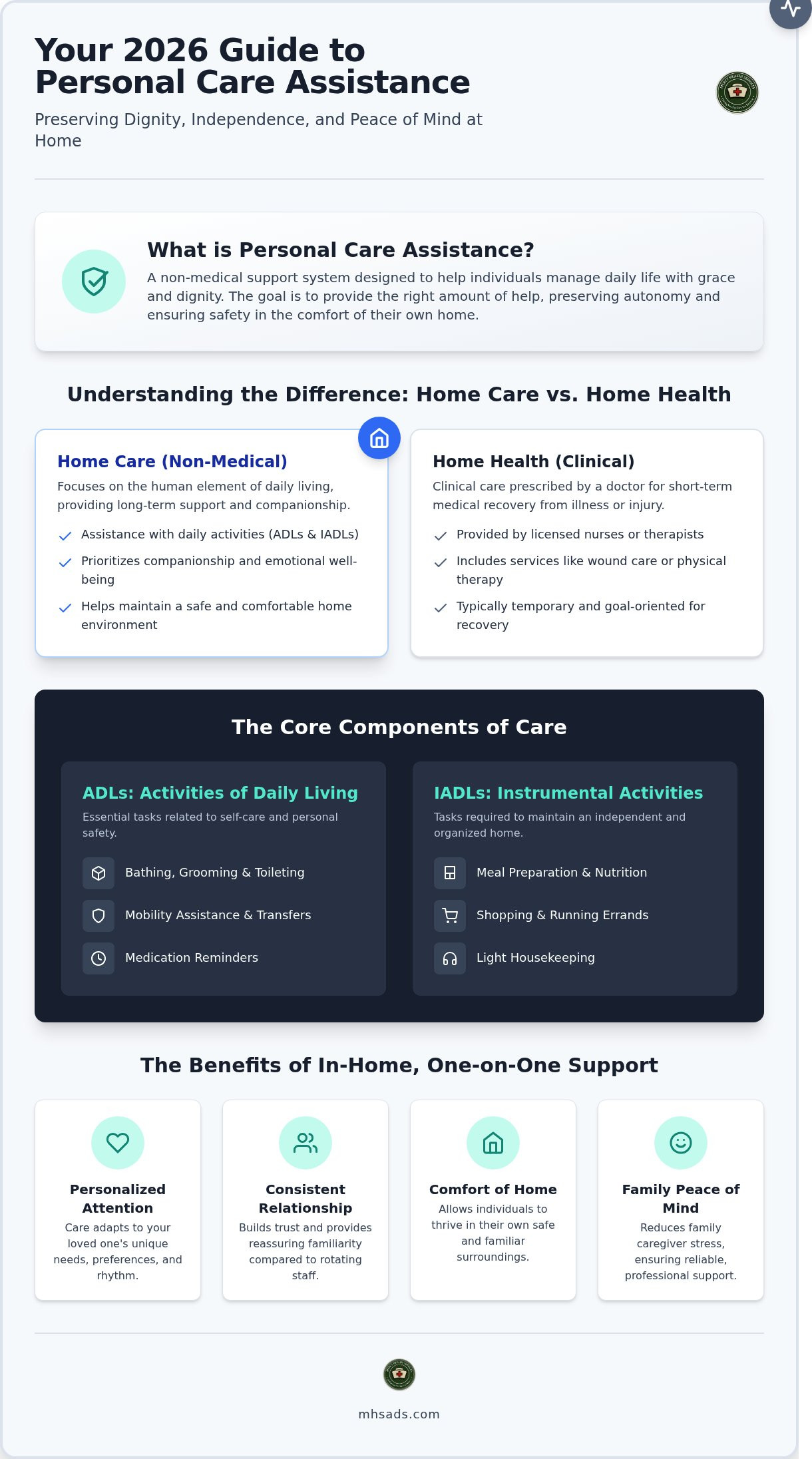
At its heart, personal care assistance is a non-medical support system designed to help individuals manage their daily lives with grace and ease. It's about providing the exact level of help needed to keep someone safe without overstepping or taking away their sense of self. We view this role as a "Compassionate Navigator." This means our caregivers don't just "manage" a client; they observe, listen, and adapt to the person's unique rhythm. The goal is always to provide help while respecting individual autonomy, ensuring that every interaction feels like a collaboration rather than a transaction.
It's vital to clarify that this specialized support is different from clinical services. While we specialize in personal care, we don't provide skilled nursing care or physical therapy. Instead, we focus on the essential tasks that make staying at home possible. This private-duty model offers a level of consistency and personalization that many families find more reassuring than rotating state-run programs. In 2026, this support is available for every life stage, including children with special needs and adults under 50 who require a helping hand due to illness or injury.
Is this the right path for your family member?
Are you noticing that simple tasks like getting dressed or preparing a meal are becoming sources of frustration for your loved one? Does the thought of them being alone throughout the day cause you a constant sense of worry? Often, the need for personal care assistance arises during a recovery from surgery or as a progressive illness begins to impact mobility. You might find yourself wondering if you're doing enough, or if a stranger can truly provide the same level of care you would. These questions are a natural part of the process. Personal care assistance serves as a vital bridge to independence in 2026, allowing your loved one to remain in the home they love while receiving the support they need.
The difference between home care and home health
To understand What is Home Care, one must look at the focus of the support provided. While "home health" is typically clinical and prescribed by a doctor for short-term medical recovery, "home care" focuses on the human element of daily living. This non-medical approach is often much more comfortable for those who value their privacy and don't want their home to feel like a mini-hospital. Our caregivers prioritize companionship and socialization, recognizing that emotional well-being is just as important as physical safety. They handle the "light lifting" of life, such as meal preparation and light housekeeping, so your family can focus on spending quality time together rather than just managing a to-do list.
The Core Components: Understanding ADLs and IADLs in 2026
How do you distinguish between a simple helping hand and the specialized support required for safe daily living? Understanding the layers of care is the first step toward finding the right balance for your family member. In the field of personal care assistance, we categorize support into two main groups: Activities of Daily Living (ADLs) and Instrumental Activities of Daily Living (IADLs). While ADLs focus on the "self" and physical body, IADLs focus on the "environment" that surrounds the individual. Together, they create a comprehensive safety net that allows for a dignified life at home.
How ADLs preserve personal hygiene and safety
When a loved one struggles with bathing, grooming, or toileting, it can be a source of significant emotional distress for both the individual and the family. Professional support ensures these tasks are handled with the utmost respect and privacy. It's not just about hygiene; it's about physical safety. For example, professional transfers from a bed to a chair significantly reduce the risk of injury for both the client and the family caregiver. Additionally, mobility assistance for seniors plays a critical role in preventing falls, which remains a leading concern for home safety in 2026. While our caregivers don't administer medication, their consistent medication reminders ensure that health routines remain on track without the stress of forgetfulness.
IADLs: Maintaining a healthy and organized home
While ADLs keep the person safe, IADLs keep the home functioning as a sanctuary. This includes tasks like light housekeeping, which reduces stress and removes allergens that can impact respiratory health. Beyond the physical environment, meal preparation for elderly at home serves as a vital tool for both nutrition and cognitive health. Our caregivers weave companionship and socialization into these daily chores. Whether it's chatting while folding laundry or sharing a story during lunch, these moments fight the isolation that often accompanies aging. If you're feeling overwhelmed by these daily demands, a free consultation can help you map out a plan that restores balance to your home.
The Benefits of One-on-One Support vs. Facility Care
How do you choose between the structured safety of a facility and the deeply personal comfort of home? Many families struggle with the fear that moving a loved one into a residential center will result in a permanent loss of independence. While facilities often operate on a "one-to-many" staff ratio, one on one senior care ensures that your family member is the sole focus of a caregiver's attention. This personalized approach means that support is delivered on their schedule, not a facility's rigid routine. Whether they need help for just a few hours or require more consistent assistance, the flexibility of private-duty care preserves their autonomy while ensuring their safety.
Staying in a familiar environment offers profound health benefits, particularly for those navigating memory challenges or cognitive decline. The presence of personal belongings, beloved pets, and established daily rhythms provides a sense of security that a clinical setting simply can't replicate. In 2026, personal care assistance is recognized as a vital way to bridge the gap between needing help and wanting to stay home. It allows for a customized experience where the caregiver adapts to the individual, rather than the individual having to adapt to an institution.
Why "Aging in Place" is the preferred choice in 2026
Why is the concept of "home" so powerful during the later stages of life? It's where memories are built and community connections are maintained. Utilizing aging in place support allows your loved one to keep their social ties with neighbors and local friends. Beyond the emotional value, home-based support can be significantly more cost-effective for families who only require targeted help for a few hours each day. You aren't paying for the high overhead of a massive facility; you're paying for dedicated, meaningful engagement that directly improves your loved one's quality of life.
The role of the background-checked caregiver
How can you feel certain that a new person in your home is both safe and capable? The answer lies in the rigorous vetting process of a professional agency. We provide peace of mind by matching your family with vetted, background-checked caregivers who are trained to be observant and proactive. A consistent caregiver does more than just complete tasks; they build a meaningful relationship based on trust. They're often the first to notice subtle changes in mood or physical health that might otherwise go overlooked by busy family members. By handling the "vetted reliability" aspect, we remove the burden of screening from your shoulders, allowing you to focus on being a supportive family member rather than a hiring manager.
Creating a Personalized Care Plan: A Roadmap for Families
How do you move from identifying a need to implementing a solution without causing friction within the family? A personalized care plan is the foundation of successful personal care assistance. This isn't a static document; it's a living roadmap that evolves as your loved one's needs change. The process begins with a careful observation of daily life. Are they struggling with buttons in the morning? Is the kitchen becoming cluttered because light housekeeping is too taxing? By conducting a quiet needs assessment at home, you can identify specific gaps where a helping hand would make the most impact.
When transitioning to home care services, it's vital to include your family member in the conversation. They need to feel empowered, not managed. Frame the discussion around their goals, such as staying in their favorite chair or continuing to enjoy their garden. A flexible plan might start with just a few hours of respite care to provide a trial period before moving toward more consistent daily support. This allows everyone to adjust at a comfortable pace.
Assessing needs across different age groups
Personal care is never a one size fits all solution. For instance, home care for special needs children focuses heavily on developmental milestones and routines that provide a sense of stability. Conversely, home care for adults under 50 often centers on maintaining professional or social lives while managing chronic illness. Each life stage requires a Compassionate Navigator who understands these unique nuances. We specialize in tailoring support that respects the individual's age, personality, and specific health journey.
How to start the conversation with a resistant loved one
What do you do if your loved one refuses the help they clearly need? It's a common challenge that requires a gentle, empathetic approach. Avoid sounding patronizing or clinical. Instead of focusing on what they can no longer do, try scripts that focus on your own peace of mind. You might say, "I worry about you being alone while I'm at work; having someone here for a few hours would help me feel so much better." Emphasize that personal care assistance is a tool for staying independent longer, not a sign of giving up. If you're ready to take the next step, request a free consultation to help guide your family through this delicate transition.
Why Professional Personal Care is the Logical Next Step
How do you know when the "helping hand" you've been providing has reached its limit? It's a difficult question to face, but choosing professional personal care assistance is often the most loving decision you can make for your family. It transforms your role from an exhausted manager of daily tasks back into a supportive family member. By acting as a Trusted Guide, professional care ensures that your loved one's needs are met with vetted reliability and a person-centered focus that respects their history and preferences. This private-duty model offers a level of consistency that rotating state-run programs often lack, providing a stable anchor for your household.
Seeking help is a proactive way to prevent the emergencies that often force a move into a facility. Are you worried about a potential fall or noticing that your loved one isn't eating as well as they used to? Professional caregivers are trained to spot these subtle changes before they become crises. By addressing mobility and nutrition early, you aren't just managing the present; you're securing a safer future where your loved one can remain in their home for as long as possible. Taking this step now ensures that safety is prioritized while your loved one still feels empowered to be part of the decision-making process.
Reducing caregiver burnout for the whole family
Caring for a family member is a beautiful journey, but it's also one that carries a heavy emotional and physical toll. Are you finding yourself more stressed by the daily to-do list than you are present in the moment? When you're constantly focused on medication reminders or light housekeeping, the quality of your relationship can begin to suffer. Professional assistance allows you to return to being a "daughter," "son," or "spouse" instead of a "nurse." It's important to remember that professional care is an investment in family harmony that protects the health of every member involved.
Next steps: Finding the right partner
What should you look for when researching home care agencies in 2026? The most important factor is finding a partner that prioritizes a custom-matched caregiver who fits your loved one's unique personality and needs. You deserve a provider that listens more than they talk and offers a clear, step-by-step pathway toward a solution. A free consultation is the best way to determine if an agency truly understands your family's dynamics and can provide the vetted reliability you require. If you're ready to find a compassionate navigator for your journey, schedule a free consultation with Mercy Health Services today.
A Brighter Path for Your Loved One’s Independence
How will your family's daily life change once the weight of caregiving is shared with a trusted partner? Choosing personal care assistance isn't a sign of giving up; it's a proactive step toward ensuring your loved one remains safe and respected in their own home throughout 2026. You've discovered that this support is a collaborative partnership that prioritizes dignity for every life stage, from children to seniors. By focusing on safety and emotional well-being, you're creating a sustainable environment where your family member can truly thrive.
Our team acts as a compassionate navigator, providing vetted, background-checked caregivers and personalized care plans tailored to your unique situation. We understand the urgency of your needs, which is why professional support is often available within just a few days. You don't have to carry this burden alone. Begin your journey to better home care with a free consultation and reclaim your role as a devoted family member. We're here to guide you every step of the way with the reliability and warmth your family deserves.
Frequently Asked Questions
What is the difference between personal care assistance and skilled nursing?
Personal care assistance focuses on non-medical support for daily living, while skilled nursing involves clinical medical procedures performed by licensed nurses. Our team specializes in helping with tasks like bathing, dressing, and mobility to ensure safety at home. We don't provide skilled nursing services or physical therapy. This distinction is important because it allows our caregivers to focus entirely on the human element of support and companionship rather than clinical management.
Can personal care assistants help with medication?
Our caregivers provide medication reminders to help your loved one stay consistent with their doctor's prescribed routine. While they don't administer injections or handle medical dosing, they act as a "Trusted Guide" by ensuring the right medicine is taken at the right time. This proactive support helps prevent the health complications that often arise from forgotten doses, giving your family greater peace of mind about daily safety in 2026.
Is personal care assistance available for children with special needs?
Yes, we offer dedicated in-home support for children with special needs as part of our commitment to all life stages. We understand that caring for a child requires a unique level of patience and a highly personalized care plan. Our caregivers focus on maintaining established routines and providing developmental support that respects the child's individuality while offering essential respite for parents and primary family caregivers who need a helping hand.
How quickly can we start receiving in-home care services?
You can often begin receiving personal care assistance within just a few days of your initial contact. We prioritize a responsive approach because we know that families often seek help during moments of transition or urgent need. The process starts with a free consultation to understand your specific requirements, followed by a professional matching process to ensure your loved one is paired with the most compatible and reliable caregiver available.
Are your caregivers background-checked and vetted?
Every caregiver on our team undergoes a rigorous vetting process, including comprehensive background checks and professional screening. We believe that trust is the foundation of any care relationship, so we take the burden of "vetted reliability" off your shoulders. This ensures that the person entering your home is not only skilled in providing support but also shares our deep commitment to treating every client with the dignity and respect they deserve.
Can I choose the schedule for my loved one’s care?
You have full control over the schedule that works best for your family's unique lifestyle and needs. Whether you require a few hours of respite care each week or more consistent daily support, our private-duty model is designed for maximum flexibility. This 2026 approach allows you to adjust the frequency and duration of visits as your loved one's needs evolve, ensuring they always have the right level of assistance without feeling pressured.
Does personal care assistance include help with housekeeping and meals?
Yes, our services include light housekeeping and meal preparation to help maintain a healthy and organized home environment. We recognize that a clean space and nutritious meals are vital for both physical health and emotional well-being. Our caregivers integrate these tasks into their daily routine, often using mealtime as an opportunity for meaningful companionship and socialization to help fight the isolation that many individuals feel when living alone or recovering from illness.
What happens if our regular caregiver is unavailable?
If your regular caregiver is unavailable due to illness or an emergency, we coordinate a qualified substitute to ensure your care remains consistent. As an organized agency, we manage the logistics of scheduling so you don't have to worry about a gap in support. We prioritize finding a replacement who is familiar with your loved one's personalized care plan, maintaining the high standards of reliability and comfort your family expects during these transitions.
Frequently Asked Questions
Are you noticing that simple tasks like getting dressed or preparing a meal are becoming sources of frustration for your loved one? Does the thought of them being alone throughout the day cause you a constant sense of worry? Often, the need for personal care assistance arises during a recovery from surgery or as a progressive illness begins to impact mobility. You might find yourself wondering if you're doing enough, or if a stranger can truly provide the same level of care you would. These questions are a natural part of the process. Personal care assistance serves as a vital bridge to independence in 2026, allowing your loved one to remain in the home they love while receiving the support they need.
Personal care assistance focuses on non-medical support for daily living, while skilled nursing involves clinical medical procedures performed by licensed nurses. Our team specializes in helping with tasks like bathing, dressing, and mobility to ensure safety at home. We don't provide skilled nursing services or physical therapy. This distinction is important because it allows our caregivers to focus entirely on the human element of support and companionship rather than clinical management.
Our caregivers provide medication reminders to help your loved one stay consistent with their doctor's prescribed routine. While they don't administer injections or handle medical dosing, they act as a "Trusted Guide" by ensuring the right medicine is taken at the right time. This proactive support helps prevent the health complications that often arise from forgotten doses, giving your family greater peace of mind about daily safety in 2026.
Yes, we offer dedicated in-home support for children with special needs as part of our commitment to all life stages. We understand that caring for a child requires a unique level of patience and a highly personalized care plan. Our caregivers focus on maintaining established routines and providing developmental support that respects the child's individuality while offering essential respite for parents and primary family caregivers who need a helping hand.
You can often begin receiving personal care assistance within just a few days of your initial contact. We prioritize a responsive approach because we know that families often seek help during moments of transition or urgent need. The process starts with a free consultation to understand your specific requirements, followed by a professional matching process to ensure your loved one is paired with the most compatible and reliable caregiver available.
Every caregiver on our team undergoes a rigorous vetting process, including comprehensive background checks and professional screening. We believe that trust is the foundation of any care relationship, so we take the burden of "vetted reliability" off your shoulders. This ensures that the person entering your home is not only skilled in providing support but also shares our deep commitment to treating every client with the dignity and respect they deserve.
You have full control over the schedule that works best for your family's unique lifestyle and needs. Whether you require a few hours of respite care each week or more consistent daily support, our private-duty model is designed for maximum flexibility. This 2026 approach allows you to adjust the frequency and duration of visits as your loved one's needs evolve, ensuring they always have the right level of assistance without feeling pressured.
Yes, our services include light housekeeping and meal preparation to help maintain a healthy and organized home environment. We recognize that a clean space and nutritious meals are vital for both physical health and emotional well-being. Our caregivers integrate these tasks into their daily routine, often using mealtime as an opportunity for meaningful companionship and socialization to help fight the isolation that many individuals feel when living alone or recovering from illness.
If your regular caregiver is unavailable due to illness or an emergency, we coordinate a qualified substitute to ensure your care remains consistent. As an organized agency, we manage the logistics of scheduling so you don't have to worry about a gap in support. We prioritize finding a replacement who is familiar with your loved one's personalized care plan, maintaining the high standards of reliability and comfort your family expects during these transitions.