2026 Guide: Personalized Care Plans for Seniors
September 9, 2026 · 17 min read
What if the support your loved one needs didn't feel like a medical intervention, but rather a natural extension of their daily life? Are you feeling overwhelmed by the logistics of managing daily tasks while worrying that professional help might feel cold or clinical? It's completely natural to feel a sense of guilt when you realize you can't provide every ounce of care personally. You want your parent to remain in the home they love, yet the fear of a fall or a missed meal keeps you up at night.
Finding that balance between safety and independence is exactly why personalized care plans for seniors are so vital in 2026. You don't have to choose between a sterile environment and your loved one's dignity. This guide will show you how to design a customized care strategy that preserves their unique lifestyle and ensures they are protected. We'll explore a clear roadmap for daily support that transforms a caregiver into a trusted companion who feels like family, finally giving you the peace of mind you deserve.
Key Takeaways
- Understand why standard care routines can feel cold and how tailored support protects your loved one's cognitive health and morale.
- Learn the essential elements of personalized care plans for seniors, from mobility assistance to nutritional support that honors their unique tastes.
- Compare the flexibility of hourly private-duty care with the fixed schedules of assisted living to find the path that best preserves independence.
- Follow a step-by-step roadmap to initiate empathetic family conversations and conduct a holistic assessment of your loved one's daily challenges.
- Discover how a "Compassionate Navigator" approach and rigorous caregiver vetting provide the reliability you need to feel confident in your choice.
Why Generic Care Fails: The Importance of Personalization for Seniors
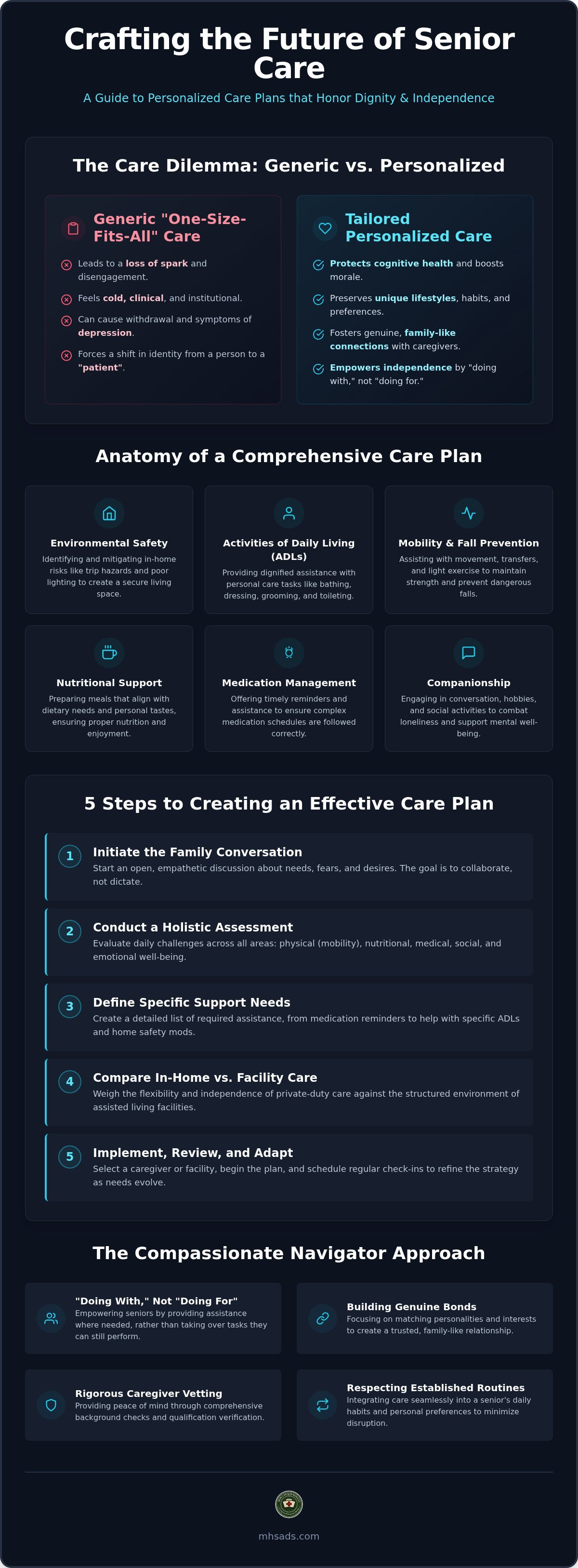
Does a standardized schedule make your loved one feel like a resident in their own home? Many families find that "one-size-fits-all" routines lead to a loss of spark and a decline in engagement. When care is treated as a series of boxes to check, the human element disappears. This is why personalized care plans for seniors are not just a luxury; they're a necessity for emotional well-being. A generic approach often overlooks the small details that make a life meaningful, such as a preferred wake-up time or a specific way of preparing a favorite meal.
The Emotional Impact of One-Size-Fits-All Care
How do rigid schedules affect a senior's mental health? When an individual is forced to follow a clinical routine, they often begin to withdraw or experience symptoms of depression. The loss of control over one's own environment is a significant fear for many aging adults. By utilizing Person-centred planning principles, we ensure that the support revolves around the individual. This method honors their lifelong habits and preferences, which is essential for maintaining cognitive health and high morale during times of transition.
Have you noticed how some care environments unintentionally turn people into "patients"? This identity shift can be devastating for someone who has spent decades as an independent leader of their family. Tailored support focuses on the person first and the assistance second. Instead of taking over every task, a compassionate caregiver identifies where help is truly needed and where the senior can still take the lead. This approach prevents the cold, clinical feel that many families worry about when seeking outside help.
How Tailored Support Preserves Senior Independence
Is it possible to provide safety without sacrificing a senior's sense of self? True independence isn't necessarily about doing everything alone; it's about having the right assistance to stay in control of one's life. Effective aging in place support identifies specific moments where a helping hand makes a difference. We focus on "doing with" rather than "doing for," which empowers the individual. Whether it's mobility assistance during a morning garden stroll or companionship during light housekeeping, these customized touches keep seniors active and engaged in their own lives.
Moving from family-only care to professional support often feels like a major hurdle. You might feel a sense of guilt, or your parent might feel resistant to a new face in the house. A personalized approach smooths this friction by introducing help gradually and thoughtfully. We focus on building a genuine bond between the caregiver and the senior. By matching personalities and respecting established routines, the transition feels like welcoming a trusted guide into the home rather than a stranger.
The Anatomy of a Comprehensive Personalized Care Plan
Have you considered what happens when a care plan overlooks the nuances of your parent's home environment? A truly effective strategy goes beyond a checklist of medical needs. It's a living document that adapts to the physical, nutritional, and emotional landscape of their daily life. When we build personalized care plans for seniors, we look at the specific layout of the home to ensure environmental safety. This includes identifying trip hazards or lighting needs that a clinical facility might miss. It's about creating a protective bubble that feels like home, not a hospital.
Nutritional support is another pillar often reduced to mere calories in generic settings. In a customized plan, we focus on preferred tastes and the joy of social dining. Does your loved one enjoy a specific brand of tea in the afternoon? Do they prefer their main meal at noon? These details matter. By incorporating medication reminders and mobility assistance into these natural rhythms, safety becomes a seamless part of the day. This level of detail ensures that your loved one stays nourished and safe without feeling managed.
Assessing Activities of Daily Living (ADLs)
Where does your family need the most support right now? We begin by breaking down the essentials of personal care assistance, which includes sensitive tasks like bathing, dressing, and grooming. We also evaluate mobility needs to prevent falls. This is particularly important in 2026, as federal nursing home staffing regulations have removed some minimum standards, making the dedicated focus of an in-home caregiver even more critical. We then determine the exact level of light housekeeping and meal prep required to keep the home running smoothly while empowering the senior to remain involved where they can.
Incorporating Socialization and Emotional Well-being
Is your loved one staying connected to the things they love? Physical safety is only half the battle; emotional health is the other. The benefits of one on one senior care are profound in reducing the isolation that often leads to cognitive decline. When designing personalized care plans for seniors, we prioritize companionship as much as physical assistance.
A dedicated companion doesn't just watch a senior; they engage in hobbies, plan small outings, and provide the steady emotional stability that comes from a long-term bond. This meaningful engagement supports mental clarity and ensures your parent feels seen and valued every single day. If you're feeling the weight of these decisions, you might consider reaching out for a free consultation to explore how a tailored approach can bring peace of mind to your entire family.
Private-Duty vs. Facility-Based Care Plans
Are you worried that a facility's fixed schedule might strip away your loved one's sense of autonomy? While assisted living facilities provide a safe environment, they operate on a collective clock that may not always align with your parent's unique rhythm. This is where the flexibility of personalized care plans for seniors truly shines. Private-duty care allows for a level of precision that large institutions simply cannot match, ensuring that the support revolves around the individual rather than the facility's staffing needs.
Choosing in-home support also offers a significant psychological advantage. The comfort of familiar surroundings helps reduce the anxiety often associated with aging. By paying only for the support actually needed, families can manage resources more effectively while keeping their loved one in the place they feel most secure. When you design personalized care plans for seniors, you aren't just selecting a service; you're preserving a lifestyle and a sense of belonging.
Flexibility in Scheduling and Intensity
How do you know when it's time to increase the level of assistance? One of the greatest benefits of private-duty care is its ability to evolve alongside your loved one's needs. Many families start with just a few hours of support each week to help with meal preparation or light housekeeping. Over time, this can seamlessly transition into more intensive support or even 24/7 care without the trauma of moving to a new location.
This adaptability is crucial for managing specific challenges like "sundowning," where a senior may need extra assistance during the late afternoon or evening hours. For families acting as primary caregivers, the role of respite care for dementia patients is a vital component of a home-based plan. It provides a necessary break for the family while ensuring the senior remains in a stable, familiar environment with a professional who understands their specific triggers and routines.
Direct Caregiver Matching and Consistency
Why is having a consistent person in the home so critical for safety? In a facility, staff rotations often mean your loved one sees different faces every shift. A private-duty plan focuses on building a long-term bond with one primary caregiver. This consistency allows the caregiver to become a "Trusted Guide" who can spot subtle changes in health or behavior that a rotating staff might overlook.
We believe that personality matching is just as important as technical skill. A caregiver who shares your loved one's interests or sense of humor quickly feels like a member of the family. Our vetted, background-checked caregivers provide the professional reassurance you need to feel confident. Knowing that a dependable, familiar person is there to provide mobility assistance or medication reminders brings a level of peace of mind that is difficult to find in larger, more transactional settings.
5 Steps to Creating an Effective Care Plan with Your Family
Are you wondering how to begin this delicate conversation without making your loved one feel defensive? It starts with a shift in perspective. Instead of presenting a finished solution, invite them to be the architect of their own support system. When families approach personalized care plans for seniors as a collaborative partnership, resistance often melts away, replaced by a shared sense of purpose. This process ensures that the resulting strategy is both practical and deeply respected by everyone involved.
Conducting a Holistic In-Home Assessment
A holistic assessment is a comprehensive review of an individual's physical, mental, and environmental needs to ensure all aspects of daily life are supported. This stage involves more than just checking a medical history. It's about observing the "micro-struggles" that often go unmentioned. Does your parent hesitate before reaching for a high shelf in the kitchen? Is the walk from the bedroom to the bathroom becoming a source of quiet anxiety? By involving the senior in this observation, you ensure they feel like a partner rather than a subject, which is essential for gaining their buy-in.
Setting Realistic Goals for Health and Safety
How do we balance the need for safety with a senior's deep desire for freedom? Effective personalized care plans for seniors focus on specific, positive outcomes. For example, rather than saying "Mom needs supervision," a goal might be "Mom wants to continue gardening safely in the backyard." This reframes the assistance as a tool for independence. Identifying these milestones helps keep everyone aligned. You'll find that transitioning to home care services becomes much easier when broken into these manageable, goal-oriented phases.
Once your goals are defined, the focus shifts to finding the right match. This involves interviewing and matching with a vetted caregiver whose personality complements your loved one's temperament. Technical skills are vital, but the emotional connection is what makes the care sustainable. Finally, remember that a care plan is never "finished." We recommend a formal review every 30 to 90 days to adjust for changes in health, mood, or routine. This methodical approach ensures the support remains relevant as life evolves. If you are ready to begin this journey, we invite you to schedule a free family consultation to explore your options.
How Mercy Health Services Crafts Your Unique Care Journey
How do you find a partner who understands that your loved one's needs are as unique as their fingerprint? At Mercy Health Services, we don't believe in off-the-shelf solutions. We serve as your "Compassionate Navigator," guiding your family through the emotional and logistical complexities of arranging support. Our process begins with a free initial consultation, where we listen more than we speak. This allows us to build personalized care plans for seniors that reflect their history, their preferences, and their daily joys. We're here to be a stable anchor for your family during this time of transition.
The Mercy promise is rooted in dignity, respect, and professional reliability. We understand that inviting someone into your home requires a high level of trust. That's why our standards for caregivers are exceptionally high. We provide a calm, capable presence that simplifies what often feels like an overwhelming process. By focusing on non-medical support and personal care, we ensure your loved one can remain in the environment where they feel most secure. Our care can often start within a few days, providing the immediate relief your family needs.
Our Vetted Caregiver Matching Process
What makes a caregiver more than just a provider of assistance? We believe it's the personal connection. Our vetting process is rigorous because your peace of mind is our priority. Every caregiver undergoes a comprehensive background check that's absolutely non-negotiable. However, we go far beyond the resume to find the right personality fit. We look for individuals who demonstrate empathy, patience, and a proactive nature. This "vetted reliability" ensures that from day one, your family feels supported by someone who truly cares.
- Rigorous background checks for every team member to ensure safety.
- Personality matching to ensure a harmonious home environment.
- Specialized training to assist with high-acuity personal care needs.
- A focus on building long-term, meaningful bonds between caregivers and families.
Continuous Monitoring and Plan Evolution
Does a care plan created today still work six months from now? We know that health and circumstances can change, sometimes quite rapidly. Our role is to be observant and proactive. We continuously track changes in health and adjust support levels accordingly. Whether it's increasing the frequency of mobility assistance or adding more medication reminders, we ensure the plan stays relevant. Family feedback is a critical part of this cycle. We listen to your observations and concerns, making adjustments to personalized care plans for seniors to ensure they always provide the right level of assistance. This collaborative approach ensures that your loved one's dignity and independence are always the primary focus.
Empowering Your Loved One's Next Chapter
Are you ready to trade the weight of caregiving logistics for the peace of mind that comes with professional support? We've explored how personalized care plans for seniors act as a blueprint for dignity, ensuring that safety never comes at the cost of independence. By choosing a private-duty approach, you're prioritizing consistency and a deep personal bond that facility-based care often lacks. This choice allows your parent to stay in the home they love while receiving support tailored exactly to their needs.
At Mercy Health Services, our vetted and background-checked caregivers are committed to providing compassionate, person-centered support that honors your family's unique story. You don't have to navigate these complex choices alone. We invite you to schedule your free consultation with Mercy Health Services to build a personalized plan today. Taking this step ensures your loved one remains the architect of their own life in the comfort of their own home. It's a journey we're honored to take with you, providing the stable anchor your family deserves.
Frequently Asked Questions
What is included in a personalized care plan for seniors?
A comprehensive plan includes a range of non-medical support tailored to the individual. This typically covers personal care assistance, mobility support to prevent falls, and companionship for emotional health. It also details specific daily tasks like meal preparation and light housekeeping. By focusing on these core areas, personalized care plans for seniors ensure that every physical and social need is met while maintaining the senior's preferred daily routine and dignity at home.
How often should a senior's care plan be reviewed and updated?
We recommend a formal review of the care plan every 30 to 90 days. This regular check-in allows us to adjust support levels as health or mobility needs evolve. If a significant life event occurs, such as a hospital discharge or a change in cognitive status, the plan should be updated immediately. Constant communication between the family and the caregiver ensures the assistance remains relevant and effective for the senior's current situation.
Can a care plan include non-medical support like meal prep and housekeeping?
Yes, non-medical support like meal preparation and light housekeeping is a fundamental part of our in-home assistance. These tasks are designed to simplify the senior's daily life and reduce the physical burden on family members. A caregiver can handle laundry, vacuuming, and cooking nutritious meals that follow the senior's specific dietary preferences. This practical help allows your loved one to focus on enjoying their hobbies and spending quality time with their family.
How do you handle a senior who is resistant to a new care plan?
Resistance is a natural reaction to the fear of losing independence. We handle this by using a "Compassionate Navigator" approach, which involves listening to the senior's concerns and involving them in the decision-making process. Introducing support gradually, perhaps starting with light companionship or housekeeping, often helps build trust. When a senior feels they're the architect of their own care plan, they're much more likely to welcome a caregiver into their home.
Is a personalized care plan more expensive than standard home care?
Personalized care isn't necessarily more expensive; in many cases, it's more cost-effective because you only pay for the specific support your loved one requires. Unlike standardized facility fees, these plans allow for flexible scheduling, ranging from a few hours a week to 24/7 assistance. By targeting only the necessary tasks, families can manage their resources better while ensuring their parent receives high-quality, one-on-one attention that standard, "one-size-fits-all" care models often lack.
How do you match a caregiver to a senior's specific personality and needs?
We look beyond technical skills to find a personality fit that feels like family. Our matching process considers the senior's temperament, hobbies, and communication style to ensure a harmonious connection. Every caregiver is a vetted, background-checked professional, providing an underlying layer of reliability. This careful selection process ensures that the caregiver isn't just a visitor, but a trusted companion who understands the nuances of personalized care plans for seniors.
What happens if our needs change and we need 24/7 care suddenly?
Our services are designed to be highly flexible and can scale quickly if your situation changes. If a sudden decline in health or a family emergency requires 24/7 care, we can often adjust the schedule and increase support within a few days. This responsiveness provides a stable anchor for families during stressful transitions. Whether you need temporary respite care or long-term around-the-clock monitoring, our team is prepared to adapt the care plan immediately.
Does a personalized care plan help with medication management?
While we don't provide skilled nursing care or medical administration, a personalized plan includes vital medication reminders. Caregivers help seniors stay on track with their prescribed schedules, ensuring they don't miss a dose or take the wrong amount. This non-medical assistance is a key part of maintaining safety at home. By integrating these reminders into the daily routine, we provide families with peace of mind regarding their loved one's health and medication compliance.
Frequently Asked Questions
A comprehensive plan includes a range of non-medical support tailored to the individual. This typically covers personal care assistance, mobility support to prevent falls, and companionship for emotional health. It also details specific daily tasks like meal preparation and light housekeeping. By focusing on these core areas, personalized care plans for seniors ensure that every physical and social need is met while maintaining the senior's preferred daily routine and dignity at home.
We recommend a formal review of the care plan every 30 to 90 days. This regular check-in allows us to adjust support levels as health or mobility needs evolve. If a significant life event occurs, such as a hospital discharge or a change in cognitive status, the plan should be updated immediately. Constant communication between the family and the caregiver ensures the assistance remains relevant and effective for the senior's current situation.
Yes, non-medical support like meal preparation and light housekeeping is a fundamental part of our in-home assistance. These tasks are designed to simplify the senior's daily life and reduce the physical burden on family members. A caregiver can handle laundry, vacuuming, and cooking nutritious meals that follow the senior's specific dietary preferences. This practical help allows your loved one to focus on enjoying their hobbies and spending quality time with their family.
Resistance is a natural reaction to the fear of losing independence. We handle this by using a "Compassionate Navigator" approach, which involves listening to the senior's concerns and involving them in the decision-making process. Introducing support gradually, perhaps starting with light companionship or housekeeping, often helps build trust. When a senior feels they're the architect of their own care plan, they're much more likely to welcome a caregiver into their home.
Personalized care isn't necessarily more expensive; in many cases, it's more cost-effective because you only pay for the specific support your loved one requires. Unlike standardized facility fees, these plans allow for flexible scheduling, ranging from a few hours a week to 24/7 assistance. By targeting only the necessary tasks, families can manage their resources better while ensuring their parent receives high-quality, one-on-one attention that standard, "one-size-fits-all" care models often lack.
We look beyond technical skills to find a personality fit that feels like family. Our matching process considers the senior's temperament, hobbies, and communication style to ensure a harmonious connection. Every caregiver is a vetted, background-checked professional, providing an underlying layer of reliability. This careful selection process ensures that the caregiver isn't just a visitor, but a trusted companion who understands the nuances of personalized care plans for seniors.
Our services are designed to be highly flexible and can scale quickly if your situation changes. If a sudden decline in health or a family emergency requires 24/7 care, we can often adjust the schedule and increase support within a few days. This responsiveness provides a stable anchor for families during stressful transitions. Whether you need temporary respite care or long-term around-the-clock monitoring, our team is prepared to adapt the care plan immediately.
While we don't provide skilled nursing care or medical administration, a personalized plan includes vital medication reminders. Caregivers help seniors stay on track with their prescribed schedules, ensuring they don't miss a dose or take the wrong amount. This non-medical assistance is a key part of maintaining safety at home. By integrating these reminders into the daily routine, we provide families with peace of mind regarding their loved one's health and medication compliance.