
Home Care for Special Needs Children: 2026 Family Guide
August 20, 2026 · 17 min read
What if the support you need isn't about replacing your role as a parent, but about finally having the space to simply be one again? You likely know the heavy weight of chronic exhaustion and the quiet anxiety that comes with the thought of trusting a stranger with your child's unique needs. It's a constant struggle to balance the intensive care one child requires while ensuring their siblings feel seen and supported. You aren't alone in feeling that your family's routine has become a series of tasks rather than a life shared together.
Choosing home care for special needs children is a significant decision that focuses on dignity and collective well-being. This 2026 guide will show you how personalized in-home support can enhance your child’s independence while providing your family the vital balance it deserves. We believe that professional assistance should feel like a collaborative partnership rather than a clinical intrusion. It's about finding a reliable anchor so you can focus on being a family.
In the following sections, we'll outline how to establish a sustainable daily routine and secure reliable help with personal care or mobility. You'll discover a pathway to peace of mind, knowing your child is safe and your family is finally finding its steady rhythm.
Key Takeaways
- Understand the vital differences between non-medical home support and clinical nursing to ensure your child receives the most appropriate daily assistance.
- Learn why one-on-one home care for special needs children offers greater flexibility and personalization than traditional group home settings or rigid programs.
- Discover practical strategies for introducing a new caregiver to your child and creating a personalized "Care Guide" to protect their unique routine.
- Explore how dedicated help with personal care and mobility provides the vital respite needed to maintain a balanced and healthy family life.
- Identify the qualities of a trusted guide who can adapt care plans as your child’s needs and milestones change over time.
Understanding the Role of In-Home Care for Children with Special Needs
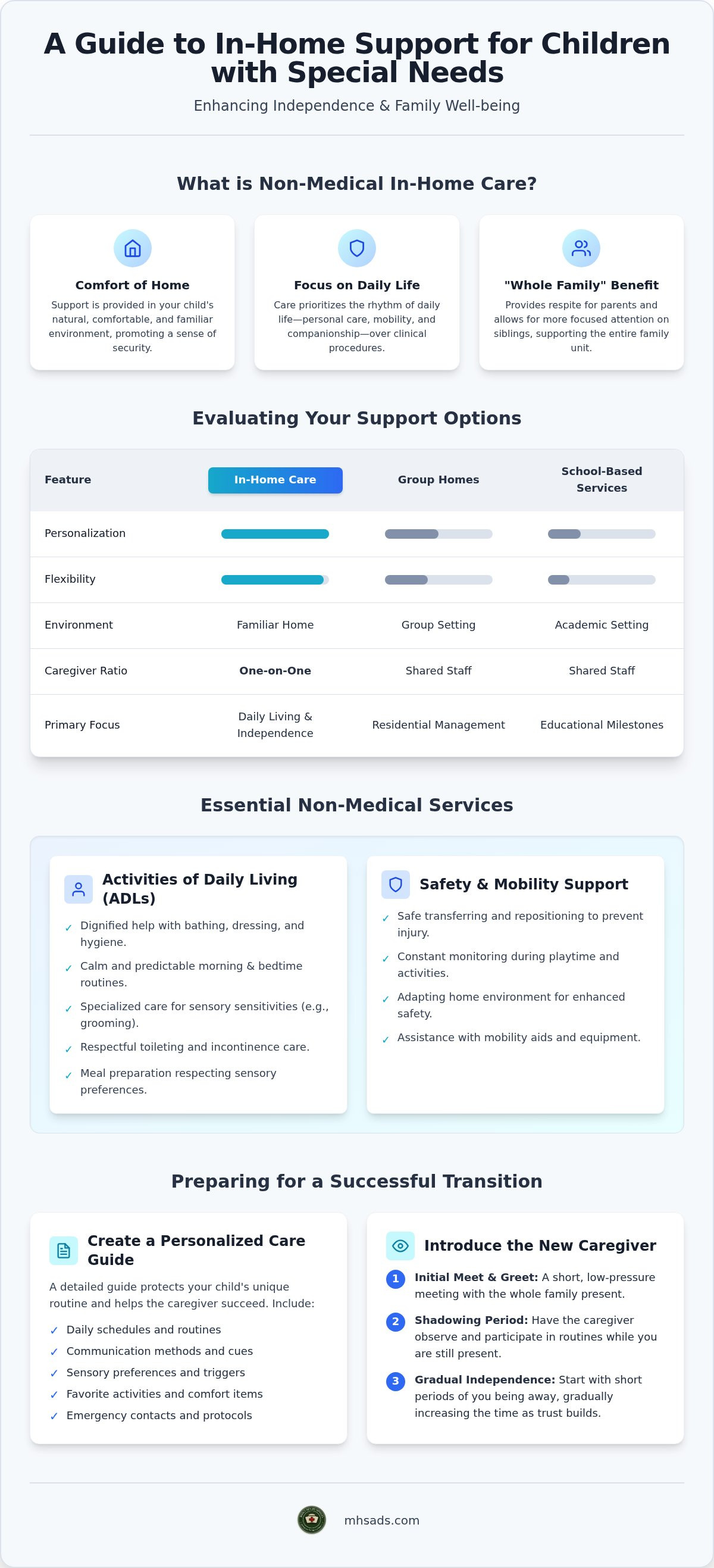
When we talk about non-medical home care for special needs children, we are describing a service that prioritizes the rhythm of daily life over clinical procedures. Unlike school-based services that focus on academic milestones or skilled nursing that manages complex medical equipment, this type of support centers on the human element. It involves dedicated assistance with personal care, mobility, and companionship within the comfort of your own four walls. This partnership isn't about replacing your role; it's about providing the steady hands needed to help your child thrive in their natural environment.
Choosing to bring a caregiver into your home is often a profound sign of parental strength. It shows a commitment to the long-term health of the entire household. Many families find that when they step away from the role of full-time "care manager," they can finally return to being a parent. This shift has a significant "whole family" benefit. It allows you to offer more focused attention to siblings who may feel the quiet weight of a household centered on one child's intensive needs. Professional support creates the breathing room necessary for every family member to feel seen and supported.
Is Your Family Ready for Outside Support?
Do you find that your daily tasks have become a source of constant, overwhelming pressure? Are you experiencing the physical toll of chronic sleep deprivation or the mental fog of caregiver burnout? Identifying the "tipping point" is a personal process, but it often happens when the joy of family life is buried under the logistics of care. Professional assistance can restore a sense of normalcy. It transforms your home from a high-stress environment back into a sanctuary where your child feels safe and understood.
The Emotional Impact of Professional Caregiving
It's natural to feel a sense of hesitation or even guilt when you first consider hiring help. You might wonder if you're the only one who can truly understand your child's cues. However, Understanding Respite Care is the first step toward building a sustainable future for your family. Utilizing respite care is a proactive way to maintain your own mental health so you can remain the stable anchor your child needs. By building a relationship of trust with a vetted caregiver, you're expanding your child's world and teaching them that they are supported by a wider community of people who value their dignity and independence.
Essential Non-Medical Services for Pediatric Home Support
How do you ensure your child’s daily routine remains respectful and tailored to their specific needs? Non-medical home care for special needs children provides a layer of support that bridges the gap between clinical care and independent living. This assistance is designed to be person-centered, focusing on the human element of daily life. It includes everything from meal preparation that respects sensory preferences to companionship that encourages social growth. By focusing on these essential daily tasks, professional support helps your child navigate their world with greater confidence and ease.
Assistance with Activities of Daily Living (ADLs)
Caregivers provide dignified help with bathing, dressing, and hygiene. Morning and bedtime routines often require the most patience and consistency. By utilizing personal care assistance at home, families can ensure these transitions are calm and predictable. For children with sensory sensitivities, grooming tasks like tooth brushing or hair washing are handled with specialized care to avoid overstimulation. This support also extends to toileting and incontinence care, where maintaining the child's dignity is always the highest priority. These small, consistent interactions build a foundation of trust between the child and their caregiver.
Safety and Mobility Support at Home
Safety is a primary concern for children with physical disabilities. While we often think of mobility assistance for seniors, these same principles of safe transferring and repositioning are adapted for pediatric care to prevent injury to both the child and the caregiver. Monitoring during playtime ensures that movement is encouraged while risks are minimized. Many of these essential supports are outlined through Medicaid Home and Community-Based Services, which help fund the non-medical assistance that keeps children in their own homes and communities. This focus on safety allows your child to explore their environment with confidence, knowing a reliable guide is always nearby.
Nutritional support is another cornerstone of effective home support. Meal preparation is more than just cooking; it involves understanding unique sensory preferences and dietary restrictions. Caregivers help prepare meals that respect a child's texture aversions or specific nutritional requirements, making mealtimes less stressful for everyone. This holistic approach ensures that your child’s physical and emotional needs are met concurrently. If you are ready to see how these services can fit into your life, you can explore our personalized care options to find the right path forward for your family.
Evaluating Home Care vs. Alternative Support Systems
How do you decide which support model fits your family’s unique rhythm? While group homes or institutional settings offer structured environments, they often lack the deep personalization that one-on-one home care for special needs children provides. Private-duty care allows for a level of flexibility that rigid, state-funded programs simply cannot match. It empowers you to set the schedule and choose a caregiver who aligns with your child's personality and your family's values. This model ensures that your child remains the central focus, rather than being one of many in a crowded facility.
This approach also complements school-based goals. If your child has an Individualized Education Program (IEP), a home caregiver can reinforce those same behavioral or social objectives during evening or weekend hours. While private pay options represent a financial commitment, the return in specialized attention and reduced family stress is often significant. According to the Health Resources and Services Administration, support systems for Children and Youth with Special Health Care Needs are most effective when they are integrated, family-centered, and consistent across all environments.
Why One-on-One Attention Matters for Developmental Growth
Consistency is the bedrock of progress. For children with Autism or ADHD, a dedicated caregiver doesn't just "supervise"; they observe subtle triggers and celebrate small milestones that might be missed in a group setting. This focused attention helps bridge the gap between therapy sessions and daily life. You'll find that a consistent face reduces the anxiety of transitions. Additionally, staying at home significantly reduces exposure to common illnesses found in larger daycare settings, protecting children with compromised immune systems or complex health profiles.
Integrating Home Care with Your Current Routine
Does your current schedule feel like a jigsaw puzzle of therapy appointments and school runs? Private-duty care is designed to fill those gaps seamlessly. Caregivers can provide medication reminders to ensure health stability throughout the day or assist with light housekeeping to keep your child’s environment organized. By handling these essential tasks, the caregiver helps maintain a safe, predictable space. This allows you to focus on the quality of your interactions rather than the logistics of the day. It’s about creating a sustainable flow that respects your child’s favorites and avoids their triggers.
Preparing Your Family for a Successful Home Care Transition
How do you introduce a new person into your child’s sanctuary without causing distress? Preparing for home care for special needs children requires a thoughtful, unhurried approach that prioritizes your child’s comfort. Start by reframing the caregiver’s role as a "new helper" who is there to join in on their favorite activities. This simple shift in language can reduce anxiety for children who are sensitive to changes in their environment. We recommend hosting an initial meeting where the focus is solely on building a connection rather than performing tasks. This allows you to observe how their personalities align before the actual care begins.
Creating a "Care Guide" is an essential step in this journey. This isn't just a schedule; it's a map of your child’s world. Does your child have a specific sensory trigger, like the hum of a vacuum? Do they have a "favorite" way to be positioned during story time? Documenting these nuances ensures that the transition feels like a continuation of your existing routine rather than a disruption. Setting clear boundaries during the first few visits helps the provider understand your family’s expectations while giving you the space to observe and provide real-time feedback.
The First 48 Hours: What to Expect
Will the first few days feel a bit different? Yes, and that's perfectly normal. Both you and your child will go through an adjustment period as you learn to share your space. We suggest establishing a "communication log" from day one. This simple tool allows the caregiver to track daily progress, moods, and small victories. It serves as a bridge of information, ensuring you don't have to repeat instructions and can see at a glance how the day went. Open, honest feedback during this window is the best way to fine-tune the care plan.
Safety and Privacy Considerations
How do you maintain a sense of privacy while welcoming a provider into your home? It begins with the peace of mind that comes from vetted reliability. Every caregiver should undergo rigorous background checks and vetting standards before they ever step through your door. To protect your family’s privacy, designate specific areas for care and keep your personal spaces private. Optimizing the home environment involves ensuring the provider has what they need to support your child safely while respecting the boundaries of your household. If you're ready to find a trusted partner for this journey, you can schedule your free consultation to begin building your personalized care plan today.
Finding a Compassionate Navigator for Your Child’s Journey
How do you find a partner who values your child’s dignity as much as you do? Seeking home care for special needs children is a deeply personal journey that requires more than just a list of services. It requires a Compassionate Navigator who understands that your child’s needs will evolve as they grow. At Mercy Health Services, we're committed to providing dignity-first pediatric care that acts as a stable anchor for your entire household. By choosing a professional partner, you aren't just hiring help; you're investing in a collaborative relationship that prioritizes your family’s collective well-being and long-term stability.
Our Vetting Process: Your Peace of Mind
Why is our vetting process the cornerstone of your peace of mind? We recognize that inviting someone into your home requires an immense amount of trust. Our standards for background checks and caregiver selection are rigorous, but we believe that technical proficiency is only the beginning. We prioritize personality matching to ensure that the caregiver’s temperament aligns with your child’s unique favorites and triggers. This focus on compatibility, combined with our commitment to providing the same friendly face for every visit, helps your child build a meaningful, consistent relationship with their support person.
Starting Your Path Toward Balance
Are you ready to transition from a cycle of exhaustion to a routine of sustainable balance? We understand that once you decide to seek help, you need it to be responsive and reliable. In many cases, we can begin services within just a few days of your initial consultation. This proactive approach is designed to prevent parental burnout before it becomes overwhelming. A professional support system offers long-term benefits that extend to every member of the family, including siblings who may need more of your focused attention. It’s about creating a household where everyone has the space they need to thrive.
Taking this first step is a profound act of love for your child and your family. You don't have to carry the weight of intensive caregiving alone. We're here to guide you through the process of creating a personalized care plan that respects your child’s independence and your family’s privacy. Every child deserves a support system that sees their potential and every parent deserves the chance to find their balance again. When you're ready to find the support your family deserves, we invite you to schedule a free family consultation to explore how we can support your journey.
Finding Your Family’s New Rhythm
How will your family’s story change when you have the dedicated support you deserve? Throughout this guide, we've explored how home care for special needs children serves as a vital bridge, transforming a high-stress household into a space of sustainable balance. You've discovered that professional assistance is not a replacement for your care, but a collaborative partnership that restores your ability to simply be a parent. By focusing on personalized routines and dignity-first support, you can ensure your child’s independence grows alongside their comfort.
Finding the right path forward begins with a single, supported step. We're here to provide vetted and background-checked caregivers who act as compassionate navigators for your child’s unique journey. Whether you need help with daily personal care or are seeking a reliable respite plan, our team is ready to build a strategy tailored specifically to your family’s needs. We invite you to Schedule a Free Consultation with Our Compassionate Care Team today. You have the strength to lead your family, and we have the dependable hands to support you every step of the way.
Frequently Asked Questions
What is the difference between home care and home health care for children?
The primary difference lies in the nature of the support provided. Home care for special needs children focuses on non-medical assistance like personal care, meal preparation, and companionship. It’s designed to help with daily life activities. In contrast, home health care involves clinical services provided by licensed nurses or therapists. While we don't provide medical treatments, our caregivers act as a stable anchor for daily routines, ensuring your child’s environment remains safe and supportive.
Can a home care provider help with my child’s behavioral therapy goals?
Our caregivers can certainly help reinforce the goals established by your child’s behavioral therapists. While we don't provide the therapy itself, we prioritize consistency by following the routines and techniques your clinical team recommends. This collaborative approach ensures that social or behavioral milestones are practiced in a natural home setting. By maintaining a predictable environment, we help your child feel secure while they work toward greater independence and social engagement.
Is home care for special needs children covered by insurance or is it private pay?
Most private-duty home care services are funded through private pay or specific long-term care insurance policies. However, many families utilize Medicaid Home and Community-Based Services (HCBS) waivers to help cover these costs. It’s a good idea to check your specific state programs, as waitlists can be long. We focus on providing transparent, person-centered support that fits your family's budget while ensuring your child receives the highest standard of non-medical assistance.
How do you ensure the safety of my child with a new caregiver?
We ensure safety through a rigorous vetting process that includes comprehensive background checks and reference verifications. Beyond technical skills, we prioritize personality matching to ensure the caregiver is a natural fit for your household. This vetted reliability means you don't have to worry about trusting a stranger. We also encourage an initial consultation to establish trust and clear boundaries, ensuring your child feels safe and supported from the very first visit.
What happens if my assigned caregiver is sick or unavailable?
If your primary caregiver is unavailable due to illness or an emergency, we work quickly to provide a suitable backup. Our goal is to maintain the consistency your child needs without disrupting your family’s routine. We understand that predictability is vital for children with special needs, so we keep a close-knit team of vetted professionals ready to step in. You'll always be informed of any changes so you can feel confident and prepared.
Can I schedule care for just a few hours a week, or is there a minimum?
We believe in providing flexible support that mirrors your family’s actual needs. While some families require daily assistance, others may only need help for a few hours a week to provide vital respite for parents. During your free consultation, we'll discuss your specific situation to create a sustainable schedule. This person-centered approach ensures you aren't forced into a rigid program that doesn't fit your life, allowing for a better balance for everyone.
How do I know if my child is a good candidate for in-home personal care?
Your child is likely a good candidate if they require assistance with activities of daily living, such as bathing, dressing, or mobility. In-home care is also beneficial for children who thrive on one-on-one companionship or need help navigating sensory triggers in a familiar environment. If you find that daily caregiving tasks are becoming overwhelming or if you need to focus more on siblings, professional home support can provide the essential balance your family deserves.
What specific disabilities or conditions do your caregivers have experience with?
Our caregivers have experience supporting children with a wide range of conditions, including Autism Spectrum Disorder, ADHD, Cerebral Palsy, and various physical or developmental disabilities. We focus on understanding the specific nuances of your child’s condition rather than applying a one-size-fits-all approach. By learning about your child’s favorite routines and specific triggers, we provide personalized assistance that respects their dignity and fosters a sense of security and meaningful engagement throughout the day.
Frequently Asked Questions
Do you find that your daily tasks have become a source of constant, overwhelming pressure? Are you experiencing the physical toll of chronic sleep deprivation or the mental fog of caregiver burnout? Identifying the "tipping point" is a personal process, but it often happens when the joy of family life is buried under the logistics of care. Professional assistance can restore a sense of normalcy. It transforms your home from a high-stress environment back into a sanctuary where your child feels safe and understood.
The primary difference lies in the nature of the support provided. Home care for special needs children focuses on non-medical assistance like personal care, meal preparation, and companionship. It’s designed to help with daily life activities. In contrast, home health care involves clinical services provided by licensed nurses or therapists. While we don't provide medical treatments, our caregivers act as a stable anchor for daily routines, ensuring your child’s environment remains safe and supportive.
Our caregivers can certainly help reinforce the goals established by your child’s behavioral therapists. While we don't provide the therapy itself, we prioritize consistency by following the routines and techniques your clinical team recommends. This collaborative approach ensures that social or behavioral milestones are practiced in a natural home setting. By maintaining a predictable environment, we help your child feel secure while they work toward greater independence and social engagement.
Most private-duty home care services are funded through private pay or specific long-term care insurance policies. However, many families utilize Medicaid Home and Community-Based Services (HCBS) waivers to help cover these costs. It’s a good idea to check your specific state programs, as waitlists can be long. We focus on providing transparent, person-centered support that fits your family's budget while ensuring your child receives the highest standard of non-medical assistance.
We ensure safety through a rigorous vetting process that includes comprehensive background checks and reference verifications. Beyond technical skills, we prioritize personality matching to ensure the caregiver is a natural fit for your household. This vetted reliability means you don't have to worry about trusting a stranger. We also encourage an initial consultation to establish trust and clear boundaries, ensuring your child feels safe and supported from the very first visit.
If your primary caregiver is unavailable due to illness or an emergency, we work quickly to provide a suitable backup. Our goal is to maintain the consistency your child needs without disrupting your family’s routine. We understand that predictability is vital for children with special needs, so we keep a close-knit team of vetted professionals ready to step in. You'll always be informed of any changes so you can feel confident and prepared.
We believe in providing flexible support that mirrors your family’s actual needs. While some families require daily assistance, others may only need help for a few hours a week to provide vital respite for parents. During your free consultation, we'll discuss your specific situation to create a sustainable schedule. This person-centered approach ensures you aren't forced into a rigid program that doesn't fit your life, allowing for a better balance for everyone.
Your child is likely a good candidate if they require assistance with activities of daily living, such as bathing, dressing, or mobility. In-home care is also beneficial for children who thrive on one-on-one companionship or need help navigating sensory triggers in a familiar environment. If you find that daily caregiving tasks are becoming overwhelming or if you need to focus more on siblings, professional home support can provide the essential balance your family deserves.
Our caregivers have experience supporting children with a wide range of conditions, including Autism Spectrum Disorder, ADHD, Cerebral Palsy, and various physical or developmental disabilities. We focus on understanding the specific nuances of your child’s condition rather than applying a one-size-fits-all approach. By learning about your child’s favorite routines and specific triggers, we provide personalized assistance that respects their dignity and fosters a sense of security and meaningful engagement throughout the day.