
Private Duty Care: 2026 Guide to In-Home Support
September 8, 2026 · 17 min read
What if the key to your loved one's independence isn't a transition to a facility, but a personalized partnership that happens right in their own living room? Are you feeling the weight of trying to be everywhere at once, perhaps even struggling with the guilt of not being able to provide constant support yourself? It's common to feel overwhelmed by the differences between medical home health and non-medical personal care, especially when safety is a constant concern. Choosing private duty care means you don't have to carry that burden alone, as it offers a dedicated way to ensure your family member receives the one-on-one attention they deserve.
We understand that inviting someone into your home is a significant decision. You likely believe that your family member deserves to stay in familiar surroundings while maintaining their dignity, and we agree that home is often the best place for healing and growth. This guide is designed to provide you with a clear understanding of how tailored support can transform daily life for children, adults, and seniors alike. You'll gain confidence in the caregiver vetting process and discover a practical roadmap for starting care that avoids family conflict. We will walk through the specific levels of assistance available, from meal preparation to mobility support, helping you navigate this transition with peace of mind.
Key Takeaways
- Learn how private duty care moves beyond simple "management" to provide a compassionate, one-on-one partnership that preserves your loved one’s dignity at home.
- Discover why this support is a vital resource for all ages, offering a stable anchor for children and adults under 50 as well as for seniors.
- Identify the specific clinical and emotional benefits of one-on-one support compared to traditional assisted living facilities.
- Explore how a personalized care plan addresses daily essentials like mobility, meal preparation, and medication reminders through a vetted caregiver.
- Gain a step-by-step roadmap for navigating difficult family conversations and managing the transition to home care within the first 48 hours.
Understanding Private Duty Care: A Personalized Approach to Home Support
Have you ever wondered why some home support feels like a series of clinical tasks while others feel like a natural extension of your family? Private duty care is designed to be the latter. It focuses on non-medical support that's tailored to the specific rhythm of your loved one's daily life. Rather than simply managing a patient, this approach centers on assisting a person. It prioritizes dignity and independence, ensuring that whether it's a child with special needs or a senior wanting to age in place, they remain the author of their own story within their own home.
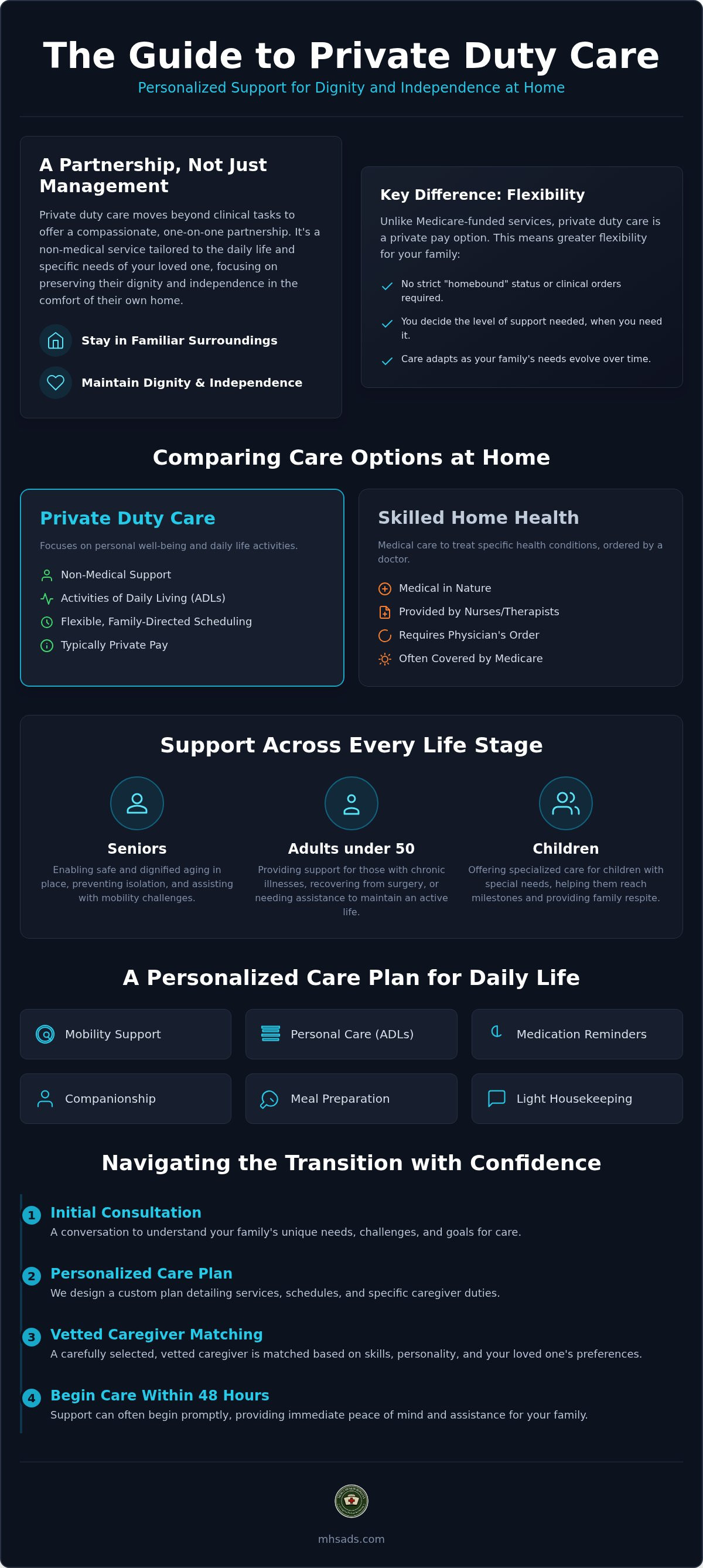
Unlike traditional Medicare services, which often come with strict eligibility requirements, this is typically a private pay service. This distinction is important because it grants you significantly more flexibility. You aren't restricted by "homebound" statuses or the need for a physician's clinical order to qualify for help. Instead, you and your family decide what level of support is necessary. This shift from "patient management" to "person-centered assistance" allows for a collaborative partnership where the caregiver adapts to the home environment, not the other way around.
Private Duty Care vs. Skilled Home Health
While both services happen at home, they serve very different purposes. Skilled home health is medical in nature, involving registered nurses or therapists who treat specific conditions. In contrast, private duty support focuses on Activities of Daily Living (ADLs). For a better Understanding Home Care and its various branches, it helps to see these services as complementary. You might use skilled nursing to recover from surgery while simultaneously relying on a caregiver for personal care assistance and mobility support. This combination ensures that both medical needs and daily comfort are fully addressed without compromise.
The Range of Support: From Hourly to 24/7
How much help is actually enough? Every family's situation is unique, which is why scheduling is intentionally flexible. Some families may only need a few hours of respite care each week to run errands or rest. Others might require overnight support or around-the-clock supervision to ensure safety for a loved one with advanced mobility challenges. As needs evolve, the care plan stays fluid. You can start with light assistance, such as meal preparation or light housekeeping, and gradually increase support if daily tasks become more difficult. This adaptability provides a steady anchor for families, often allowing support to begin within a few days of an initial consultation.
Who Benefits from Private Duty Care? Support Across Every Life Stage
Does private duty care only apply to seniors? While many associate in-home assistance with the golden years, this support is actually a versatile resource for every stage of life. It serves as a stable anchor for any family facing a transition, whether that's a new diagnosis or a sudden change in mobility. By providing personalized attention, Home Care Services like these ensure that dignity remains the priority regardless of the recipient's age. This specialized approach is as much about the emotional well-being of the family as it is about the physical assistance provided to the individual.
Isolation doesn't discriminate by age. For a young adult with a chronic illness or a senior living alone, the absence of meaningful engagement can be just as taxing as physical limitations. Private duty care bridges this gap through companionship and socialization, transforming a quiet house into a space of active connection. It's about more than just checking boxes on a list; it's about recognizing the human need for presence and empathy. When a caregiver enters the home, they aren't just there to perform tasks, they're there to offer a reassuring presence that reduces the anxiety of being homebound.
Support for Children and Young Adults
Parents often feel a unique pressure to be everything for their children, but you don't have to navigate these challenges in isolation. Seeking home care for special needs children can provide the necessary balance to help your child reach developmental milestones while giving the rest of the family room to breathe. For adults under 50 living with disabilities or chronic conditions, this assistance empowers them to maintain social connections and daily routines that might otherwise feel out of reach. It’s a partnership that fosters independence rather than creating dependence, allowing younger clients to engage with the world on their own terms.
Empowering Seniors to Age in Place
Most seniors view their home as their ultimate sanctuary. Comprehensive aging in place support is often what prevents premature facility placement, allowing your loved one to stay where they feel most secure. This is especially critical for those navigating memory care, dementia, or Alzheimer’s, where a familiar environment provides essential safety and comfort. If you're wondering how to begin this journey, you can always speak with a compassionate navigator to explore your options. By keeping the focus on the individual, home remains a place of health, respect, and meaningful engagement.
Comparing Care Options: Why One-on-One Support Matters
Why does the ratio of caregivers to clients matter so much for your family member's well-being? In many facility settings, a single staff member might be responsible for fifteen residents at once, which naturally limits the time they can spend with any one individual. With private duty care, that ratio is always one-to-one. This dedicated focus allows for the development of one on one senior care where the caregiver learns the subtle nuances of your loved one's personality, preferences, and daily rhythms.
Consistency isn't just a comfort; it's a safety feature. When the same person visits every day, they're the first to notice small changes in appetite, sleep patterns, or mood that could signal a larger health concern. This proactive approach often leads to better health outcomes and significantly fewer hospital readmissions because issues are caught before they escalate into emergencies. It transforms the experience from a series of clinical check-ins into a meaningful bond built on trust and dependability.
Home Care vs. Assisted Living
Choosing between staying at home and moving to a facility is a deeply personal decision that impacts more than just your budget. While assisted living offers a community setting, private duty care preserves the privacy and autonomy that many individuals value most. Staying in familiar surroundings has a profound psychological impact, providing a sense of stability that is often lost during a major transition. To better understand the Types of In-Home Services available, it's helpful to look at how personal care and companionship can be integrated into a daily routine without the rigid schedule of a facility. This allows your loved one to remain the decision-maker in their own home.
The Role of Respite Care for Family Caregivers
Are you feeling the physical and emotional exhaustion that often comes with constant caregiving? It's okay to admit that you need a break. Utilizing respite care for dementia patients is a proactive step toward preventing family burnout. Whether you need short-term help for a family vacation or a long-term solution for an emergency, respite care ensures your loved one is safe while you recharge. Taking this time for yourself doesn't mean you're doing less. It means you're ensuring you can be a more present, effective, and compassionate caregiver when you return. A rested caregiver is a better partner in the journey of support.
Designing a Personalized Care Plan: What to Expect
How do you transform a general need for help into a daily routine that actually works? The journey begins with a free initial consultation, which is a collaborative conversation to understand your family's unique dynamics and preferences. During this meeting, we look beyond the basic tasks to identify specific needs like medication reminders and meal preparation for elderly at home. This isn't about fitting your loved one into a pre-set program. It's about building a private duty care plan that respects their history, personality, and current level of independence.
A professional agency acts as a compassionate navigator during this stage, helping you prioritize what matters most. We understand that every family member has different comfort levels with receiving assistance, so we move at a pace that feels right for everyone involved. By focusing on personalization, we ensure that private duty care feels like a natural addition to the household rather than an intrusion. This process sets the stage for a long-term partnership built on mutual respect and consistent support.
Assessing the Activities of Daily Living (ADLs)
We use a methodical approach to determine where support is needed most. This often involves a checklist of Activities of Daily Living, such as bathing, dressing, and safe transfers. For many, mobility assistance for seniors is a cornerstone of the plan because it directly reduces the risk of falls and subsequent hospital visits. We also look at how light housekeeping and nutrition can be integrated into the day to keep the home environment organized and healthy. By identifying these gaps early, we ensure that every hour of assistance provides maximum value and comfort.
The Caregiver Selection and Vetting Process
Reliability is the foundation of trust, and we don't take that responsibility lightly. Professional agencies utilize a rigorous vetting process that includes comprehensive background checks and professional reference verification. We look for specific personality traits like empathy, patience, and a proactive nature because these are what make a caregiver a true partner. Once we understand your needs, we match you with a caregiver whose skills and personality align with your loved one's temperament. This careful matching process allows for a seamless start of care, often within just a few days of your first call.
Are you ready to see how a tailored approach can simplify your daily routine? You can schedule your free consultation today to begin designing a plan that prioritizes your family's peace of mind and dignity.
Navigating the Transition to Private Duty Care with Confidence
How do you begin a conversation about help when you know it might be met with resistance? It's natural for a loved one to feel protective of their privacy and their routine. The transition often feels less like a loss of control and more like a gain in safety when it's approached as a collaborative choice. By focusing on private duty care as a way to maintain their current lifestyle rather than a step toward a facility, you shift the narrative from "supervision" to "support." This subtle change in language can make a significant difference in how the assistance is received.
Once the decision is made, the actual transitioning to home care services follows a predictable timeline. In the first 48 hours, the focus is on building rapport and establishing a comfortable rhythm. This period is dedicated to fine-tuning the care plan and ensuring the caregiver understands the specific nuances of the home environment. It's also the time to set clear boundaries and expectations for the caregiver-family relationship. Establishing how updates will be shared and how daily tasks will be handled ensures that everyone stays on the same page from the very first visit.
Professional care is truly an investment in the entire family's quality of life. When a vetted professional handles the physical demands of personal care or mobility assistance, family members are freed from the role of "manager." This allows you to return to being a daughter, son, or spouse again, focusing on meaningful engagement rather than a checklist of chores. It reduces the weight of caregiver burnout and replaces it with the peace of mind that comes from knowing a reliable partner is present.
Overcoming Common Objections
Many individuals fear that accepting help means losing their independence. You can address this by framing private duty care as a tool for autonomy. Having someone assist with meal preparation or light housekeeping actually preserves energy for the activities your loved one enjoys most. If the concern is about having a "stranger" in the house, emphasize the matching process we discussed earlier. Remind them that the caregiver is a professional who has been specifically chosen to fit their personality. Finding a balance between professional help and family involvement ensures that the support feels like a natural extension of the home rather than an intrusion.
Next Steps: Your Path to Peace of Mind
Are you ready to take the next step toward a more supported daily life? Scheduling your free consultation is the best way to begin the discovery process and have your specific questions answered. You'll also want to start preparing your home by clearing walkways and ensuring necessary supplies are easily accessible for the caregiver's arrival. This proactive preparation helps the "start of care" feel organized and calm for everyone involved. Speak with a Compassionate Navigator at Mercy Health Services today to explore how we can help your family navigate this transition with dignity and confidence.
Empowering Your Family’s Journey Toward Home Support
Are you ready to trade the stress of constant caregiving for the peace of mind that comes with a trusted partner? We've explored how private duty care offers more than just assistance; it provides a pathway to independence for children, adults, and seniors alike. By choosing a model that focuses on one-on-one engagement, you ensure your loved one receives the undivided attention they deserve in the place they love most. This approach isn't about managing a condition, it's about supporting a person.
You don't have to navigate these complex decisions in isolation. With vetted, background-checked caregivers and personalized care plans tailored to your family's unique dynamics, the transition to home support can be both smooth and reassuring. Our team is here to act as your navigator, simplifying the process and prioritizing dignity every step of the way. Schedule a Free Consultation with Mercy Health Services to discover how compassionate, one-on-one support can transform your daily routine. You've already taken the first step by seeking information, and we're here to help you take the next one with confidence.
Frequently Asked Questions
What is the main difference between private duty care and home health care?
The primary difference is that private duty care focuses on non-medical assistance with daily tasks, whereas home health care provides clinical, medical treatment. Are you looking for help with bathing, dressing, or meal preparation? This support addresses essential daily needs to maintain independence. Home health care, in contrast, is usually ordered by a doctor for short-term recovery and includes services like wound care or physical therapy that we don't provide.
Is private duty care covered by Medicare or private insurance?
Traditional Medicare and most health insurance plans typically don't cover non-medical private duty care because it's considered "custodial" rather than medical care. Most families choose to pay for these services privately or through long-term care insurance. This private-pay model actually offers you more flexibility. You don't need a physician's order or a "homebound" status to start receiving support, allowing you to customize the frequency and duration of visits.
Can I choose my own caregiver with a private duty agency?
While the agency handles the vetting and scheduling, you play a central role in the caregiver selection process. We match clients with caregivers based on both the required skills and personality compatibility to ensure a meaningful bond. Do you feel that a specific temperament would work best for your loved one? If the initial match doesn't feel quite right, we'll work with you to find a different professional who better aligns with your family’s unique dynamics.
Do private duty caregivers provide medical services like injections or wound care?
No, these caregivers don't provide clinical medical services such as injections, wound care, or physical therapy. Our role is to provide non-medical assistance with activities of daily living. If your loved one requires medical supervision, you'll need to coordinate with a separate skilled nursing provider. Mercy Health Services focuses exclusively on support like medication reminders, mobility assistance, and personal care to help clients remain safe and comfortable at home.
How quickly can private duty care services begin for my family?
You can often begin receiving support within just a few days of your initial inquiry. We start with a free consultation to understand your specific needs and create a personalized care plan. Once the plan is in place and we've matched you with a vetted caregiver, care can start quickly. This responsive timeline is designed to reduce the stress of sudden transitions, providing your family with a stable anchor during a challenging time.
Is there a minimum number of hours required for private duty care visits?
Scheduling is highly flexible and tailored to your family's specific requirements. Whether you need a few hours of respite care to run errands or require around-the-clock supervision for safety, we can accommodate your needs. There is no rigid, one-size-fits-all requirement. We offer both hourly visits and extended-hour support, allowing you to adjust the level of care as your loved one's needs evolve or as your own schedule changes.
How do you ensure the safety and reliability of your caregivers?
We prioritize safety by ensuring every caregiver undergoes a rigorous vetting process before entering your home. This includes comprehensive background checks and thorough professional reference verification. Are you concerned about the reliability of someone new? Our agency handles all the screening and preparation so you don't have to. We only employ caregivers who demonstrate empathy, patience, and a high standard of professional dependability, ensuring they're a trusted guide for your family.
Can private duty care help with specialized needs like dementia or Parkinson’s?
Yes, this support is an excellent resource for managing the daily challenges of dementia, Parkinson’s, or other chronic conditions. While we don't provide medical treatment, our caregivers offer essential non-medical support like mobility assistance, meal preparation, and constant companionship to prevent falls and reduce isolation. This specialized attention helps clients with memory or movement disorders maintain a sense of routine and dignity while ensuring they remain safe in their familiar home environment.
Frequently Asked Questions
The primary difference is that private duty care focuses on non-medical assistance with daily tasks, whereas home health care provides clinical, medical treatment. Are you looking for help with bathing, dressing, or meal preparation? This support addresses essential daily needs to maintain independence. Home health care, in contrast, is usually ordered by a doctor for short-term recovery and includes services like wound care or physical therapy that we don't provide.
Traditional Medicare and most health insurance plans typically don't cover non-medical private duty care because it's considered "custodial" rather than medical care. Most families choose to pay for these services privately or through long-term care insurance. This private-pay model actually offers you more flexibility. You don't need a physician's order or a "homebound" status to start receiving support, allowing you to customize the frequency and duration of visits.
While the agency handles the vetting and scheduling, you play a central role in the caregiver selection process. We match clients with caregivers based on both the required skills and personality compatibility to ensure a meaningful bond. Do you feel that a specific temperament would work best for your loved one? If the initial match doesn't feel quite right, we'll work with you to find a different professional who better aligns with your family’s unique dynamics.
No, these caregivers don't provide clinical medical services such as injections, wound care, or physical therapy. Our role is to provide non-medical assistance with activities of daily living. If your loved one requires medical supervision, you'll need to coordinate with a separate skilled nursing provider. Mercy Health Services focuses exclusively on support like medication reminders, mobility assistance, and personal care to help clients remain safe and comfortable at home.
You can often begin receiving support within just a few days of your initial inquiry. We start with a free consultation to understand your specific needs and create a personalized care plan. Once the plan is in place and we've matched you with a vetted caregiver, care can start quickly. This responsive timeline is designed to reduce the stress of sudden transitions, providing your family with a stable anchor during a challenging time.
Scheduling is highly flexible and tailored to your family's specific requirements. Whether you need a few hours of respite care to run errands or require around-the-clock supervision for safety, we can accommodate your needs. There is no rigid, one-size-fits-all requirement. We offer both hourly visits and extended-hour support, allowing you to adjust the level of care as your loved one's needs evolve or as your own schedule changes.
We prioritize safety by ensuring every caregiver undergoes a rigorous vetting process before entering your home. This includes comprehensive background checks and thorough professional reference verification. Are you concerned about the reliability of someone new? Our agency handles all the screening and preparation so you don't have to. We only employ caregivers who demonstrate empathy, patience, and a high standard of professional dependability, ensuring they're a trusted guide for your family.
Yes, this support is an excellent resource for managing the daily challenges of dementia, Parkinson’s, or other chronic conditions. While we don't provide medical treatment, our caregivers offer essential non-medical support like mobility assistance, meal preparation, and constant companionship to prevent falls and reduce isolation. This specialized attention helps clients with memory or movement disorders maintain a sense of routine and dignity while ensuring they remain safe in their familiar home environment.