
The 2026 Family Safety Checklist: Hiring Background Checked Caregivers for Total Peace of Mind
August 22, 2026 · 17 min read
If a single piece of paper says a person is safe, do you truly feel the weight of worry lift from your shoulders? When you're inviting a stranger into your home to care for a parent or a child, a simple checkmark next to a name doesn't always provide the comfort you need. You deserve more than a surface level assurance that your family is protected from harm or exploitation. It's natural to feel a mix of hope and deep anxiety as you search for the right support. You want to ensure your loved one's dignity is respected while keeping them physically and financially secure.
In this 2026 checklist, you'll learn how to verify credentials and why a multi-layered approach is the only way to find truly reliable background checked caregivers. We'll explore the difference between basic database searches and comprehensive behavioral assessments that reveal true character. This guide provides a clear framework for vetting candidates, giving you the confidence to make a hiring decision that brings genuine peace of mind to your entire household.
Key Takeaways
- Understand why simple online searches aren't enough. Learn why background checked caregivers vetted through multi-layered agency protocols offer superior protection for your family.
- Discover how to look beyond a clean criminal record by assessing a candidate's professional reliability and emotional empathy during the interview process.
- Learn the specific components of a modern security check, including national database cross-referencing and identity verification, to ensure total peace of mind.
- Identify the risks of private hiring and how professional agencies provide ongoing monitoring to ensure consistent safety over time.
- Gain a clear framework for selecting a partner who prioritizes your family's dignity through rigorous character assessments and personalized care matching.
Why Background Checked Caregivers are the Foundation of Home Care
How do you balance the need for support with the instinct to protect your home? Inviting someone into your private space is an act of profound vulnerability. It's not just about getting help with meal preparation or mobility assistance; it's about trusting another person with the keys to your life. This level of intimacy requires security standards that go far beyond what you might expect in a typical workplace. Because the home is a private sanctuary, the risks of misconduct are often hidden from public view, making the initial vetting process your most important line of defense.
Professional background checked caregivers are the essential foundation of this trust. While many families feel a sense of urgency to find help quickly, skipping the vetting process can lead to significant emotional and physical risks. A "clean record" on a basic website search doesn't always equal a safe caregiver. True safety comes from a multi-layered approach that looks at character, professional history, and behavioral consistency. When a caregiver is properly vetted, it preserves the dignity of your loved one, allowing them to receive support without feeling like their home has become an open door for risk.
The Risks of Unvetted Care
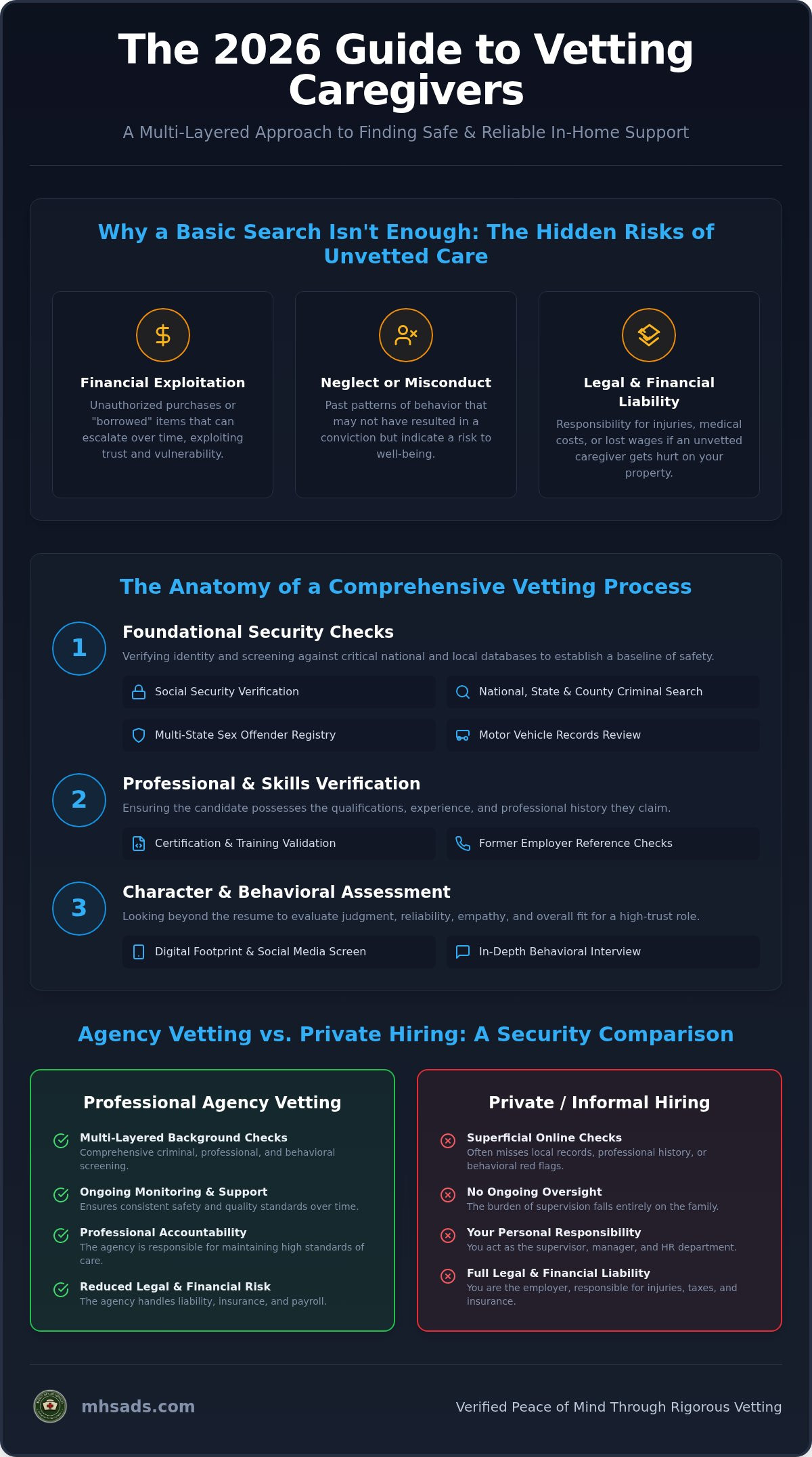
Hiring someone through an informal marketplace or a social media group may seem easier, but it leaves your family exposed to several dangers. Financial exploitation often starts with small, "borrowed" items or unauthorized purchases that gradually escalate over time. Without a professional background check, you also lack insight into past patterns of neglect or misconduct that might not have resulted in a conviction yet. Beyond physical safety, you face legal liability; if an unvetted independent contractor is injured in your home, you could be held responsible for medical costs and lost wages.
The Psychology of Peace of Mind
Have you found yourself spending more time monitoring the caregiver than enjoying time with your parent? When you work with an agency that provides background checked caregivers, your internal role shifts. You can stop acting as a supervisor and return to being a daughter, a son, or a spouse. This professional accountability reduces the heavy burden of family caregiver burnout by ensuring someone else is responsible for the high standards of care. Peace of mind is the quiet confidence that your loved one is being supported by a person of integrity who has been chosen for their empathy as much as their credentials.
The Anatomy of a Modern Caregiver Background Check
When you see the phrase "background checked," what do you picture? Many families assume it's a single, definitive report that gives a simple "yes" or "no" on safety. In reality, the most reliable background checked caregivers are vetted through a complex, multi-layered process that leaves no stone unturned. A modern check starts with a Social Security verification to ensure the person is exactly who they claim to be. From there, it moves into a deep dive of criminal records, cross-referencing national, state, and county-level databases. This is vital because local records often contain details that national searches might miss due to reporting delays or jurisdictional gaps.
Safety in the home also requires looking at specific registries and records that impact daily life. A multi-state sex offender registry search is a mandatory requirement for any reputable agency. If the caregiver will be helping with errands or medical appointments, a review of motor vehicle records is essential to ensure they have a history of safe driving. These technical layers create a safety net, but they're only the beginning of a truly comprehensive vetting strategy.
Beyond Criminal Records: Professional Verification
A clean record tells you what a person hasn't done, but it doesn't tell you what they are capable of doing. Validating a candidate's experience in personal care assistance is the only way to ensure they have the skills to handle the physical and emotional demands of the job. This involves verifying certifications and training specifically related to mobility assistance and medication reminders. Speaking directly to former employers is often more revealing than any paper check; it allows us to hear firsthand about their punctuality, empathy, and professional boundaries.
Digital Footprint and Social Media Screening
Character often leaves a digital trail that criminal reports don't capture. In 2026, assessing a caregiver's social media presence has become a vital tool for identifying red flags like poor judgment or a lack of professional discretion. This isn't about prying into a person's private life, but rather ensuring their public behavior aligns with the high standards of dignity and respect your family deserves. A Digital Character Check is now a 2026 standard for verifying that a caregiver’s online persona reflects the same reliability they present in person. If you're feeling overwhelmed by these technical steps, you can always reach out for a consultation to see how we handle this complex vetting for you.
Agency Vetting vs. Private Hiring: A Security Comparison
Are you considering hiring a caregiver privately to save on costs? It's a common path for many families, yet it often comes with hidden risks that only surface when it's too late. The most significant pitfall is the "Instant Check" trap. You've likely seen websites offering background reports for $19 or $29, promising total peace of mind in seconds. These services often rely on fragmented, outdated databases that miss recent filings or county-level records. Relying on these cheap reports creates a false sense of security, leaving your loved one vulnerable to individuals who know how to navigate the gaps in automated systems.
Professional agencies offer a level of oversight that is impossible for a private employer to maintain. One of the most critical differences is ongoing monitoring. A private hire might have a clean record on day one, but what happens if their circumstances change six months later? Agencies track these changes, ensuring that background checked caregivers remain compliant with safety standards throughout their entire employment. Furthermore, if a check comes back with a "hit," the agency carries the burden of proof and the difficult task of disqualifying the candidate, sparing you from a potentially uncomfortable or confrontational situation.
The Checklist for DIY Hiring
If you choose to hire independently, you must be prepared to act as your own private investigator. This process is time-consuming and often more expensive than families anticipate. To do it correctly, you'll need to:
- Request a national criminal search combined with specific county searches for every place the candidate has lived.
- Verify their Social Security number and legal right to work.
- Check the national sex offender registry and motor vehicle records.
- Manage the awkwardness of asking a stranger for their fingerprints and sensitive personal data.
The emotional weight of this process can be taxing, especially when you're already managing the stress of a family transition.
The Agency Advantage
At Mercy Health Services, we act as your "Compassionate Navigator," handling the heavy lifting of vetting so you don't have to. We apply the "Mercy Standard" to every candidate, which means we look for a rare combination of professional reliability and genuine empathy. Our process ensures that the person entering your home is not just someone with a clean record, but a professional dedicated to preserving your family's dignity. This rigorous approach is especially vital for vulnerable populations, as detailed in our Home Care for Special Needs Children: 2026 Family Guide. By choosing a partner that prioritizes these standards, you gain the freedom to focus on your relationship with your loved one rather than their security protocols.
The Interview Checklist: Vetting for Personality and Fit
Have you ever felt a "gut feeling" that didn't quite match what you saw on a candidate's resume? While background checked caregivers have passed the necessary legal and security hurdles, the face-to-face interview is where you discover if they possess the heart and temperament for the work. A clean record is the baseline, but the interview is where you assess the "soft skills" that ensure your loved one's safety and emotional well-being. This step is about finding a professional who doesn't just perform tasks but respects the sanctuary of your home.
Reliability often reveals itself before the first question is even asked. Punctuality and clear communication during the scheduling process are early indicators of professional dependability. If a candidate struggles to arrive on time or fails to respond to messages promptly, it's a sign that they may lack the consistency required for home care. During the meeting, pay close attention to the "Intuition Check." A background check is a vital safety net, but it's only half the battle. You must feel a sense of ease and trust when they speak about their approach to caregiving.
Assessing empathy is perhaps the most critical part of the meeting. Observe how the caregiver interacts with your family member. Do they make eye contact? Do they speak directly to your loved one with respect, or do they treat them as a secondary participant in the conversation? A caregiver who prioritizes dignity will naturally seek to build a connection based on mutual trust rather than just clinical management.
Critical Questions to Ask Every Caregiver
To move beyond surface-level answers, use scenario-based questions that test for patience and judgment. Ask, "How do you handle stressful situations or resistance to care?" This reveals their ability to remain calm when a loved one is frustrated or confused. Another vital question is, "Can you describe a time you had to manage a safety emergency?" Their response should demonstrate a clear, logical thought process. You should also ask specific questions regarding mobility assistance for seniors and their experience with fall prevention techniques to ensure they can physically support your loved one safely.
Identifying Subtle Red Flags
While some warnings are obvious, others are more nuanced. Be wary of inconsistency in their employment timeline or vague reasons for leaving previous positions. A lack of professional boundaries, such as asking overly personal questions or sharing inappropriate details about their own life, is a significant concern. Perhaps the most telling red flag is any resistance to the idea of a formal, agency-led background check. A true professional understands the weight of their responsibility and will welcome the vetting process as a way to prove their reliability. If you want to skip the stress of this vetting process and move straight to meeting qualified candidates, connect with our team at Mercy Health Services to start your search with confidence.
Verified Peace of Mind with Mercy Health Services
How do you find the strength to trust again after feeling overwhelmed by the search for care? At Mercy Health Services, we understand that you aren't just looking for a worker; you're looking for a person who will cherish your loved one's dignity as much as you do. Our commitment to providing background checked caregivers is built on the belief that safety is the prerequisite for meaningful connection. We don't simply fill shifts. Instead, we carefully match families with professionals based on a delicate balance of technical skills and individual character traits. This ensures that the person entering your home is a natural fit for your family's unique rhythm and emotional needs, providing a stable anchor during times of transition.
Safety isn't a one-time event; it's a continuous promise that requires constant attention. Every arrangement begins with a personalized care plan that serves as a roadmap for consistency and security. This plan outlines specific needs, from medication reminders to mobility assistance, ensuring that every interaction is purposeful and safe. By establishing these clear expectations from day one, we remove the guesswork and provide a stable environment where your loved one can thrive. These plans are not static; they evolve as your family's needs change, ensuring that the support provided remains relevant and effective.
Our Multi-Layered Vetting Process
We believe that meeting the legal minimum isn't enough when it comes to your family's sanctuary. Our vetting process goes deeper than standard checks, incorporating rigorous character assessments and professional reference checks that look for the "Mercy Standard" of warmth and reliability. Once a caregiver is placed, our role doesn't end with the introduction. We maintain ongoing supervision and actively seek family feedback to ensure that our high standards are met every single day. This dedicated oversight is a cornerstone of our specialized support, such as providing respite care for children with disabilities in Maryland. It allows us to be proactive rather than reactive, catching potential issues before they impact your family's peace of mind.
A Partner in Your Care Journey
Are you ready to move from a place of anxiety to a place of confidence? As your Compassionate Navigator, we handle the complexities of vetting background checked caregivers and coordinating schedules so you can focus on being present for your family. We know that needs can arise suddenly, which is why our process is designed for both thoroughness and speed. In many cases, we can have the right support in place within just a few days. Your journey toward peace of mind starts with a simple, pressure-free conversation. We invite you to schedule your free consultation with Mercy Health Services today to discover how we can support your family with dignity and vetted reliability.
Embracing a Future of Secure and Compassionate Care
Choosing the right support is a journey that requires both a careful eye and a trusting heart. By focusing on a multi-layered vetting process, you've taken the first step toward ensuring your loved one's dignity and physical safety are never compromised. You now understand that a clean record is only the beginning. True security comes from a combination of deep data searches and behavioral assessments that reveal a caregiver's genuine character. Relying on professional background checked caregivers allows you to step back from the role of a supervisor and return to being a supportive family member.
At Mercy Health Services, we're committed to being your trusted guide through this complex process. Our empathy-led hiring and personalized care plans for all ages ensure that every caregiver meets the highest standards of reliability and warmth. You deserve to feel confident in the people you invite into your home. Ensure your family’s safety, schedule a free consultation with our vetted caregivers today. We're here to help you find the perfect balance of expert assistance and total peace of mind.
Frequently Asked Questions
What does a caregiver background check actually include?
A comprehensive check includes criminal history searches at national, state, and county levels. It also verifies Social Security numbers to confirm identity and cross references the sex offender registry. If the role involves transportation, motor vehicle records are reviewed. Beyond these databases, a thorough check involves validating professional certifications and speaking directly with former employers to assess the caregiver's past performance and reliability.
Can I run a background check on a caregiver myself?
While you can use online search tools, they often miss critical local records that haven't been digitized. These services rely on databases that aren't always updated in real time, providing a false sense of security. To match the depth of an agency check, you'd need to contact individual county courthouses and verify identity documents manually. This process is often more expensive and stressful for families to manage alone.
How often should a caregiver’s background check be updated?
Best practices suggest that background checks should be updated at least once a year. While the initial vetting is a vital first step, circumstances can change over time. Professional agencies often use continuous monitoring systems that alert them to new legal filings or incidents immediately. This proactive oversight ensures that your family remains protected long after the first day of service, offering a layer of safety that private hiring lacks.
What are the red flags to look for in a caregiver background check?
Significant red flags include unexplained gaps in employment or a history of frequent, short term jobs at different agencies. You should also watch for inconsistent address histories or motor vehicle violations that suggest a lack of judgment. A major warning sign is any resistance to the vetting process itself. A professional caregiver understands the need for transparency and will be comfortable providing the information required for a thorough character assessment.
Is a name-based background check enough for home care safety?
A name-based check is rarely enough because it can miss records if a person uses an alias or has a common name. Fingerprint-based checks are much more reliable as they link directly to a person's unique biometric data. For the highest level of safety, name-based searches should be part of a multi-layered strategy. This approach includes identity verification, social media screening, and professional reference checks to build a complete picture of character.
What happens if a caregiver has a minor offense on their record?
Each situation is evaluated individually, focusing on the nature of the offense and the time that has passed. Minor, non-violent incidents from many years ago might not automatically disqualify a candidate, but they do prompt a deeper conversation about character. However, any history involving violence, theft, or exploitation is an immediate disqualification. Our priority is always to protect the dignity and safety of your loved one by maintaining the highest possible standards.
How does Mercy Health Services vet their caregivers differently?
We use the "Mercy Standard," which means we look for a rare combination of professional skill and genuine heart. Our background checked caregivers are vetted through multi-layered criminal searches, but we also conduct deep character interviews. We speak with every reference to ensure each caregiver is someone we would trust in our own homes. This methodical approach ensures that we match your family with a person who is both capable and compassionate.
Are background checks required by law for all home care workers?
Legal requirements vary by state, but most licensed professional agencies are required to perform these checks by law. If you hire someone privately, there is often no legal mandate for vetting, which places the burden of safety entirely on your shoulders. Working with a professional partner who provides background checked caregivers means you are following the highest safety regulations. This approach protects vulnerable family members from the risks associated with unvetted support.
Frequently Asked Questions
A comprehensive check includes criminal records at county, state, and national levels, along with sex offender registries and Social Security verification. A thorough process also examines motor vehicle records and professional certifications to ensure total safety. These layers confirm that the individual's identity is valid and their history is transparent. By looking at multiple jurisdictions, we catch discrepancies that a single database might miss. This approach provides the foundation for a safe home environment.
Yes, you can use online services, but these often lack the depth and real-time accuracy of professional agency screenings. Private hiring requires you to collect sensitive personal data and manage the logistics of fingerprinting. It's often more expensive and time-consuming for families to access the same level of data that an organized agency provides. Most families find that letting a professional partner handle this burden reduces anxiety and ensures much higher security.
Background checks should be reviewed annually at a minimum, though professional agencies often use continuous monitoring systems. These systems alert us immediately if a caregiver has a change in circumstances or a new legal issue. Relying on a check from three years ago is risky because life situations evolve. Consistent updates ensure that the high standards you established at the start of care remain in place for the long term.
Key red flags include unexplained employment gaps, multiple addresses in a short time, or any history of financial misconduct. You should also watch for inconsistencies between their resume and the official record. A person's resistance to the vetting process itself is often a sign of underlying issues. While a record is a snapshot of the past, these patterns help us assess the caregiver's current reliability and professional judgment.
No, a name-based check is often insufficient because it can be bypassed with aliases or simple spelling variations. Fingerprint-based checks or Social Security verification are much more reliable for confirming a person's true identity. Using background checked caregivers who have undergone multi-layered verification is the only way to be certain of who is entering your home. This prevents the false security that comes from basic, low-cost online searches.
Minor offenses are evaluated on a case-by-case basis, considering the nature of the act and how long ago it occurred. We look for patterns of behavior rather than isolated, non-violent incidents from the distant past. However, any offense involving theft, violence, or neglect is an immediate disqualifier. Our goal is to balance fairness with the absolute safety and dignity of your loved one, ensuring only the most dependable professionals are placed.
We go beyond legal minimums by combining deep data searches with intensive behavioral interviews and character assessments. Our Mercy Standard ensures that every professional is chosen for their empathy and reliability as much as their clean record. We also provide ongoing supervision and collect regular family feedback to maintain high standards. This person-centered approach ensures that our background checked caregivers are not just safe, but a warm and supportive presence in your home.
Requirements vary significantly by state, but most licensed agencies are legally mandated to perform at least a basic criminal check. However, independent contractors or private hires often fall into a gray area where no legal requirement exists. This is why it's vital to partner with an agency that sets its own rigorous internal standards. Don't assume the law covers every safety detail; instead, choose a provider that prioritizes vetting as a core value.