
Home Care for Parkinson's Patients: A Comprehensive 2026 Resource Guide
August 28, 2026 · 17 min read
What if the most effective way to manage Parkinson's wasn't about increasing supervision, but about expanding the possibilities for independence? Are you finding yourself constantly watching the clock for the next medication dose or holding your breath every time your loved one stands up? It's a heavy burden to carry, and the fear of a sudden fall or a "freezing" episode can make home care for Parkinson's patients feel like a series of quiet emergencies. You want to provide the best possible life for your family member, yet the exhaustion of being a full-time caregiver often leaves you feeling drained and anxious about the future.
We understand that seeking assistance is a deeply personal choice, and it's one that should be rooted in respect rather than just clinical monitoring. This guide is designed to help you navigate these evolving challenges with confidence and clarity. You'll discover how professional support can create a secure, fall-proof environment while ensuring that medication management remains precise and stress-free. By the end of this resource, you'll have a clear pathway to reducing caregiver burnout and helping your loved one maintain their dignity and autonomy for as long as possible.
Key Takeaways
- Understand how consistent assistance through home care for Parkinson's patients helps navigate the unpredictable "on/off" periods while maintaining a stable daily routine.
- Identify the four essential pillars of daily support-mobility, medication reminders, nutrition, and personal care-that prioritize safety and dignity.
- Learn how to "Parkinson's-proof" your living space by addressing environmental triggers, such as poor lighting, that can lead to freezing or falls.
- Discover how respite care provides a vital path to preventing family burnout and sustaining a high quality of life for everyone involved.
- Explore the "Mercy Method" for introducing professional assistance into the home, ensuring a compassionate match based on personality and specialized experience.
Understanding the Evolving Needs of Parkinson's Care at Home
What does it mean to truly support someone living with Parkinson’s? It's often much more than just keeping them safe. It's about understanding the subtle, daily shifts that define the disease. Professional home care for Parkinson's patients is a non-medical support system designed to assist with both motor symptoms, like tremors or stiffness, and non-motor symptoms, such as sleep disturbances or mood changes. Unlike a clinical setting, this approach focuses on the person, not just the diagnosis, ensuring they feel seen and respected.
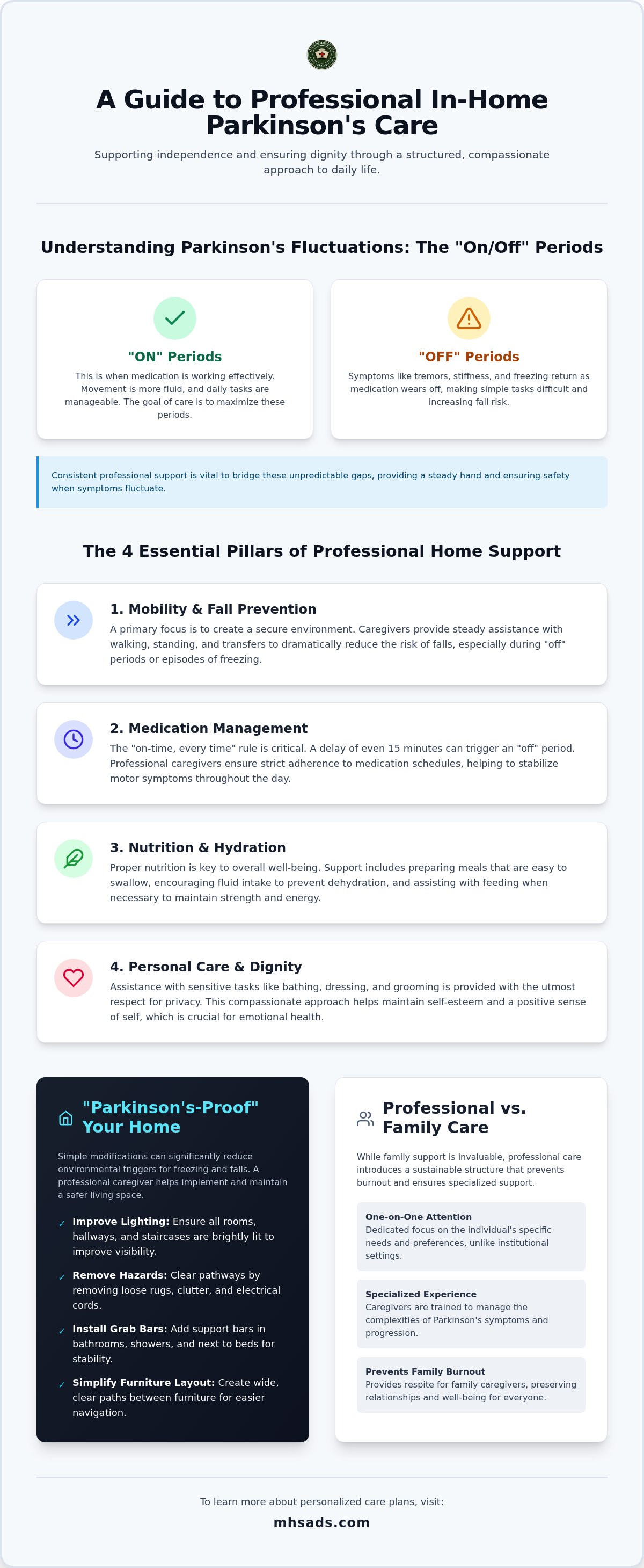
Have you noticed how your loved one’s energy and mobility seem to change from hour to hour? This fluctuating nature is often referred to as "on" and "off" periods. During "on" times, medication works well and movement is fluid. During "off" times, symptoms return, making simple tasks feel impossible. Consistency in home support is vital because it ensures someone is there to bridge those gaps. It provides a steady hand when the day feels unpredictable, helping to maintain a sense of calm and reliability.
While many associate Parkinson's with older age, it also affects younger individuals. Navigating Young-Onset Parkinson's (YOPD) requires a different strategy, as these individuals may still be working or raising families. We provide specialized home care for adults under 50 to address these unique lifestyle needs. This ensures that a diagnosis doesn't stop someone from living a full, active life. Over time, families often find that the transition from "helping out" to a structured care plan is the most loving step they can take to preserve everyone’s well-being.
The Progressive Nature of Care
Does the level of help needed today feel different than it did six months ago? Parkinson’s is a journey that evolves through distinct phases. In the early stages, support might look like companionship, help with organization, or encouragement to stay active. As the disease moves into the middle stage, the need for mobility assistance and medication reminders becomes more frequent. By the advanced stage, a more structured plan involving personal care or even 24/7 assistance ensures that safety and dignity remain the top priorities.
Why Professional Home Care vs. Institutional Care?
Why do so many families choose to remain at home? The benefits of "aging in place" are significant for cognitive health and emotional stability. Staying in a familiar environment allows for the maintenance of cherished routines and a sense of personal control. Unlike a large facility, professional home support offers dedicated one-on-one attention. This personalized partnership ensures that the caregiver is deeply attuned to the specific needs and preferences of your loved one, providing a level of care that feels like a natural extension of the family.
Core Pillars of Professional Parkinson's Home Support
How do you ensure every day remains safe and predictable when symptoms feel anything but? Effective home care for Parkinson's patients rests on four essential pillars: Mobility, Medication, Nutrition, and Personal Care. These aren't just items on a checklist. They're the foundation of a dignified life that prioritizes independence over clinical supervision. By focusing on these core areas, professional assistance transforms the home into a stable environment where your loved one can thrive despite the challenges of a progressive illness.
Personal care assistance is often the most sensitive aspect of support. Bathing, dressing, and grooming can become frustrating hurdles that impact a person's self-esteem. A compassionate caregiver provides the right level of help to ensure these tasks are completed safely while always honoring the individual's privacy. This dignified approach helps maintain a sense of self, which is just as important as physical safety. If you're feeling overwhelmed by these daily demands, speaking with a care coordinator can help you find a sustainable path forward.
Consistency is the secret to managing Parkinson’s effectively. This is especially true for medication reminders. The "on-time, every time" rule is a necessity for managing motor fluctuations. Even a 15-minute delay in a dose can cause a person to slip into an "off" period, where movement becomes difficult and tremors increase. Caregivers act as a reliable anchor, ensuring that the timing of every dose is respected to keep symptoms as stable as possible throughout the day.
Mobility and Fall Prevention Strategies
Freezing of gait can feel like your feet are suddenly glued to the floor. It's a frightening experience that often leads to falls. Our caregivers use specific verbal and visual cueing techniques to help "restart" movement during these episodes. This might include rhythmic counting or using a visual target on the floor to step toward. We also provide assistance with daily range-of-motion exercises to maintain flexibility. For more detailed safety strategies, explore our Senior Mobility Guide 2026.
Nutrition and Meal Preparation
Did you know that what a person eats can affect how their medication works? Protein timing is a subtle but vital factor, as it can sometimes interfere with the absorption of certain Parkinson’s drugs. Specialized meal preparation for elderly at home ensures that nutrition supports, rather than hinders, the treatment plan. We also address swallowing difficulties, known as dysphagia, by adapting food consistency and focusing on hydration to help manage blood pressure fluctuations and other non-motor symptoms.
Comparing Care Models: Family Support vs. Private-Duty Care
When does the role of a loving family member shift into that of a full-time care coordinator? It's a question many families face as symptoms progress. While providing all the support yourself is often a choice made from deep affection, it can lead to a significant "caregiver burden." Without the balance of professional home care for Parkinson's patients, the relentless demands of monitoring medication and assisting with mobility can lead to total exhaustion. Seeking a partnership with a professional provider isn't about stepping away. It's about ensuring that the care your loved one receives is sustainable for everyone involved.
Respite care serves as a vital bridge in this journey. It provides temporary relief that allows family members to rest, attend to their own health, or simply take a breath. Many families find that private-duty support offers a level of personalization that institutional settings simply can't match. Because this is a private-pay model, the focus remains entirely on your specific needs rather than a one-size-fits-all medical protocol. This investment in highly personalized assistance often results in a higher quality of life and more meaningful daily interactions.
Identifying Caregiver Burnout
Are you noticing red flags like chronic fatigue, unusual irritability, or neglecting your own medical appointments? These are clear signs of burnout. When you're constantly on high alert for the next "off" period or fall risk, your own well-being often takes a back seat. Professional support restores the natural family dynamic. By removing the "nurse" role from a spouse or child, it allows you to focus on being a partner or a daughter again. Having a vetted, third-party caregiver also provides a psychological reset, offering a calm and objective presence in the home.
The Flexibility of Private-Duty Care
One of the greatest advantages of private-duty care is its ability to adapt to your schedule. Unlike rigid facility schedules, this model offers a "middle ground" of support. You might choose hourly assistance for specific high-need times, such as the morning routine when stiffness is often at its peak. If sleep disturbances or nocturnal restlessness become an issue, overnight support ensures that your loved one is safe while you get the rest you need. This support scales seamlessly, allowing you to increase or decrease the hours of assistance as the disease evolves over time.
Designing a Parkinson’s-Safe Home Environment
Could the layout of your living room be contributing to your loved one’s anxiety about falling? Creating a "Parkinson's-Proof" home is about more than just safety. It's about restoring a sense of confidence and autonomy. Effective home care for Parkinson's patients begins with a proactive assessment of the physical environment to eliminate common triggers for freezing and falls. By making small, strategic adjustments, you can transform a house from a series of obstacles into a supportive sanctuary that respects your loved one's need for independence.
Consider this room-by-room checklist to identify potential hazards:
- Lighting: Shadows on the floor can often be mistaken for obstacles, which may trigger a freezing episode. Ensure bright, uniform lighting in hallways and entryways.
- Flooring: Remove every throw rug immediately. These are the most frequent causes of trips and falls. Ensure all transitions between rooms are level and non-slip.
- Accessibility: Installing grab bars and raised toilet seats provides the necessary foundation for personal care assistance, making daily hygiene routines safer and more dignified for everyone.
The Bedroom and Bathroom
Turning in bed often becomes a source of frustration as the disease progresses. Have you considered using satin sheets or installing bed rails? These simple additions can make a world of difference in nocturnal mobility, allowing for easier movement with less physical exertion. In the bathroom, a sturdy shower chair and a handheld showerhead allow for a seated, controlled bathing experience. Organizing these spaces to reduce clutter and maintain clear walking paths is essential for preventing the "start-stop" movement patterns that lead to instability.
Technology and Aids
Modern aids are designed to bridge the gap between difficulty and independence. Weighted utensils can help manage tremors during mealtime, while button hooks simplify the morning routine. Smart home features, like voice-activated lights or thermostats, ensure that your loved one never has to move through a dark room just to find a switch. Emergency response systems also play a vital role, giving you peace of mind that help is always reachable. If you need help identifying which modifications are right for your unique situation, connect with our team for a personalized home assessment.
Navigating the Transition to Professional In-Home Care
How do you talk about bringing help into the home without making your loved one feel like they're losing their autonomy? This is perhaps the most delicate conversation a family will have, and it requires a gentle, collaborative approach. Introducing home care for Parkinson's patients is not about taking away control; it’s about providing the specific tools and assistance needed to preserve it. When framed as a way to stay active and safe in their own home, the idea often becomes much less intimidating and more like a strategic partnership.
We utilize the 'Mercy Method' to ensure this transition feels like a natural step forward rather than a clinical intervention. This process involves matching vetted, background-checked caregivers based on both their specific Parkinson's experience and their personality. We believe that a caregiver should be a companion and a trusted guide, not just a visitor. By finding someone who shares similar interests or a compatible temperament, the relationship becomes a source of strength rather than a reminder of limitations.
Starting small is often the most effective way to build trust. You don't have to begin with 24/7 support. Many families find success by starting with simple companionship or light housekeeping. These services allow the patient to get comfortable with a new presence in the home without feeling like their personal space is being invaded. As the bond grows and the benefits of professional support become clear, the care plan can evolve to include more focused mobility or personal care assistance that matches the disease's progression.
Building Trust and Dignity
Empowerment is the cornerstone of a successful care partnership. Whenever possible, involve your loved one in the caregiver selection process. This gives them a sense of agency and ensures their voice is heard. Our approach to home care for Parkinson's patients is built on the belief that dignity is non-negotiable. Caregivers are trained to focus on 'support for independence,' assisting with tasks that have become difficult while encouraging the patient to continue doing what they can. This professional presence provides family members with immense peace of mind, knowing that every interaction is rooted in respect and vetted reliability.
Next Steps: Your Free Consultation
What should you expect when you're ready to explore your options? An initial home care assessment is a relaxed, consultative meeting where we listen to your concerns and observe the current home environment. We don't just provide a service; we create a roadmap tailored to your family's specific journey. This plan is designed to be flexible, scaling as needs change over time. If you're ready to discover how personalized support can change your daily life, schedule a free consultation with Mercy Health Services today.
Embracing a Future of Support and Dignity
Are you ready to shift your focus from the daily stress of caregiving back to the meaningful moments with your loved one? We've explored how a strategic home safety plan and consistent medication reminders can transform a house into a secure sanctuary. By prioritizing mobility and nutrition, professional home care for Parkinson's patients ensures that independence remains the central goal of every interaction. You don't have to navigate these evolving motor and non-motor challenges alone; a partnership built on respect can provide the stability your family needs to move forward with confidence.
Our team is here to act as your compassionate navigator. We offer vetted and background-checked caregivers who specialize in creating personalized care plans for patients of all ages. Whether you need hourly assistance or more comprehensive support, we're dedicated to honoring your loved one's autonomy. Secure compassionate, professional home care for your loved one-contact Mercy Health Services. We invite you to reach out for one of our free family consultations to begin building your roadmap. You've already taken the first step by seeking information; now, let's work together to ensure your home remains a place of comfort and joy.
Frequently Asked Questions
Does Medicare cover long-term home care for Parkinson's patients?
Medicare typically doesn't cover home care for Parkinson's patients when the needs are primarily custodial, such as assistance with bathing, dressing, or meal preparation. It's designed to pay for short-term skilled nursing or rehabilitative therapies after a specific medical event. For the consistent, daily support required to manage progressive symptoms, families usually rely on private-pay options or long-term care insurance. This allows for a more personalized level of assistance that goes beyond limited clinical requirements.
How do caregivers handle 'freezing' episodes during walking?
Caregivers handle freezing episodes by using specialized cueing techniques that help the brain bypass the motor block. This often includes rhythmic counting, humming, or asking the individual to step over an imaginary line on the floor. By providing a calm, steady presence, the caregiver reduces the anxiety that often worsens these episodes. These proactive strategies are essential for maintaining safety and preventing falls during daily transitions or walks through the home environment.
Can a Parkinson's patient stay at home safely in the advanced stages?
Staying at home during advanced stages is entirely possible when a structured, 24/7 support system is in place. As mobility becomes more limited and cognitive changes arise, the home environment must be fully adapted with safety equipment like hospital beds or lift chairs. Professional home care for Parkinson's patients provides the constant monitoring needed to prevent complications while ensuring your loved one remains in the comfortable, familiar surroundings they cherish most.
What is the difference between home health care and private-duty home care?
The primary difference lies in the type of support provided and the duration of the service. Home health care involves clinical medical services, such as wound care or physical therapy, and is usually ordered by a doctor for a limited time. Private-duty care focuses on non-medical assistance with daily living activities, companionship, and medication reminders. This model offers the flexibility of long-term support that adapts as the disease progresses over several years.
How do we introduce a caregiver to a parent who is resistant to help?
Introducing help is often most successful when you frame it as a way to support the entire family rather than just the individual. You might start with light housekeeping or meal preparation to build a relationship before moving into personal care. Involving your parent in the selection process helps them feel a sense of control. This gradual approach allows trust to develop naturally, making the transition feel like a choice rather than an imposition.
What specific training should a Parkinson's caregiver have?
A qualified caregiver should have specific training in the "on-time, every time" medication rule and safe transfer techniques to prevent falls. They also need to understand how to manage non-motor symptoms like anxiety or sleep disturbances. Knowledge of dysphagia and proper food consistency is vital for safe meal preparation. At Mercy Health Services, we ensure our background-checked caregivers have the specialized experience necessary to navigate these unique and evolving challenges with confidence.
How much does hourly in-home care for Parkinson's typically cost?
Hourly rates for in-home support vary significantly depending on your geographic location and the level of assistance required. Since these services are highly personalized, the cost reflects the dedicated one-on-one attention your loved one receives. It's best to consult with a provider to discuss your specific needs and receive a clear estimate. Many families find that this investment provides a sustainable alternative to institutional care while preserving the patient's independence and dignity.
Can home care assist with Young-Onset Parkinson's (YOPD)?
Professional assistance is highly effective for those living with Young-Onset Parkinson's. For individuals under 50, support often focuses on maintaining a career, managing a household, or staying active with children. Care plans are tailored to these specific lifestyle goals, providing the extra help needed during "off" periods so the individual can continue to lead a full, productive life. This flexible assistance adapts to the unique rhythm of YOPD and provides essential relief for the family.
Frequently Asked Questions
Why do so many families choose to remain at home? The benefits of "aging in place" are significant for cognitive health and emotional stability. Staying in a familiar environment allows for the maintenance of cherished routines and a sense of personal control. Unlike a large facility, professional home support offers dedicated one-on-one attention. This personalized partnership ensures that the caregiver is deeply attuned to the specific needs and preferences of your loved one, providing a level of care that feels like a natural extension of the family. How do you ensure every day remains safe and predictable when symptoms feel anything but? Effective home care for Parkinson's patients rests on four essential pillars: Mobility, Medication, Nutrition, and Personal Care. These aren't just items on a checklist. They're the foundation of a dignified life that prioritizes independence over clinical supervision. By focusing on these core areas, professional assistance transforms the home into a stable environment where your loved one can thrive despite the challenges of a progressive illness. Personal care assistance is often the most sensitive aspect of support. Bathing, dressing, and grooming can become frustrating hurdles that impact a person's self-esteem. A compassionate caregiver provides the right level of help to ensure these tasks are completed safely while always honoring the individual's privacy. This dignified approach helps maintain a sense of self, which is just as important as physical safety. If you're feeling overwhelmed by these daily demands, speaking with a care coordinator can help you find a sustainable path forward. Consistency is the secret to managing Parkinson’s effectively. This is especially true for medication reminders. The "on-time, every time" rule is a necessity for managing motor fluctuations. Even a 15-minute delay in a dose can cause a person to slip into an "off" period, where movement becomes difficult and tremors increase. Caregivers act as a reliable anchor, ensuring that the timing of every dose is respected to keep symptoms as stable as possible throughout the day.
Medicare typically doesn't cover home care for Parkinson's patients when the needs are primarily custodial, such as assistance with bathing, dressing, or meal preparation. It's designed to pay for short-term skilled nursing or rehabilitative therapies after a specific medical event. For the consistent, daily support required to manage progressive symptoms, families usually rely on private-pay options or long-term care insurance. This allows for a more personalized level of assistance that goes beyond limited clinical requirements.
Caregivers handle freezing episodes by using specialized cueing techniques that help the brain bypass the motor block. This often includes rhythmic counting, humming, or asking the individual to step over an imaginary line on the floor. By providing a calm, steady presence, the caregiver reduces the anxiety that often worsens these episodes. These proactive strategies are essential for maintaining safety and preventing falls during daily transitions or walks through the home environment.
Staying at home during advanced stages is entirely possible when a structured, 24/7 support system is in place. As mobility becomes more limited and cognitive changes arise, the home environment must be fully adapted with safety equipment like hospital beds or lift chairs. Professional home care for Parkinson's patients provides the constant monitoring needed to prevent complications while ensuring your loved one remains in the comfortable, familiar surroundings they cherish most.
The primary difference lies in the type of support provided and the duration of the service. Home health care involves clinical medical services, such as wound care or physical therapy, and is usually ordered by a doctor for a limited time. Private-duty care focuses on non-medical assistance with daily living activities, companionship, and medication reminders. This model offers the flexibility of long-term support that adapts as the disease progresses over several years.
Introducing help is often most successful when you frame it as a way to support the entire family rather than just the individual. You might start with light housekeeping or meal preparation to build a relationship before moving into personal care. Involving your parent in the selection process helps them feel a sense of control. This gradual approach allows trust to develop naturally, making the transition feel like a choice rather than an imposition.
A qualified caregiver should have specific training in the "on-time, every time" medication rule and safe transfer techniques to prevent falls. They also need to understand how to manage non-motor symptoms like anxiety or sleep disturbances. Knowledge of dysphagia and proper food consistency is vital for safe meal preparation. At Mercy Health Services, we ensure our background-checked caregivers have the specialized experience necessary to navigate these unique and evolving challenges with confidence.
Hourly rates for in-home support vary significantly depending on your geographic location and the level of assistance required. Since these services are highly personalized, the cost reflects the dedicated one-on-one attention your loved one receives. It's best to consult with a provider to discuss your specific needs and receive a clear estimate. Many families find that this investment provides a sustainable alternative to institutional care while preserving the patient's independence and dignity.
Professional assistance is highly effective for those living with Young-Onset Parkinson's. For individuals under 50, support often focuses on maintaining a career, managing a household, or staying active with children. Care plans are tailored to these specific lifestyle goals, providing the extra help needed during "off" periods so the individual can continue to lead a full, productive life. This flexible assistance adapts to the unique rhythm of YOPD and provides essential relief for the family.