

Preventing Caregiver Burnout: A 2026 Guide
August 12, 2026 · 17 min read
What if the most important person you need to care for right now isn't actually your loved one, but yourself? It is a difficult question to face when you are already managing constant physical fatigue and surviving on just a few hours of sleep. You might feel that wanting a break is a sign of failure, or worry that no one else can provide the same level of attention. However, burnout isn't a failure of your willpower; it is a failure of infrastructure. By exploring preventing caregiver burnout services, you aren't stepping away from your responsibilities. Instead, you are building a sustainable foundation that protects your health and ensures your loved one receives high-quality, consistent care.
We understand the heavy weight of guilt and the anxiety that comes with trusting someone else in your home. It is natural to feel that you must be the one to do everything. This guide will help you identify the subtle, early signs of exhaustion before they become overwhelming and show you how to implement professional support that fits your family's unique needs. We will look at the latest 2026 resources, including the Medicare GUIDE Model and state-level assistance, to help you transition from being an exhausted individual to a supported, healthy caregiver.
Key Takeaways
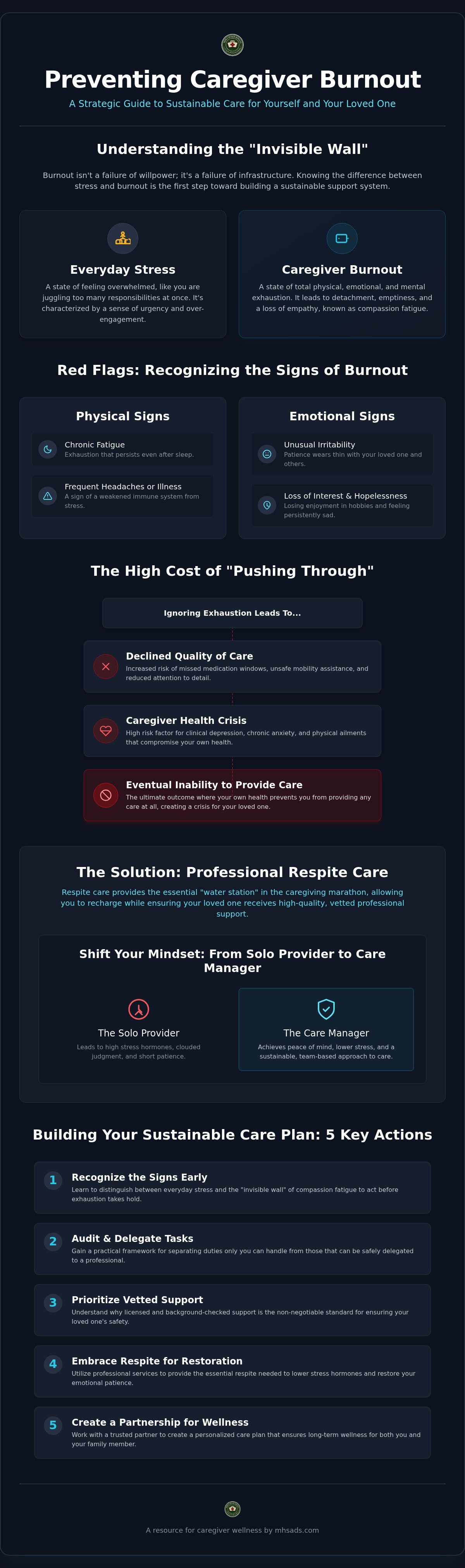
- Learn to distinguish between everyday stress and the "invisible wall" of compassion fatigue so you can act before exhaustion takes hold.
- Discover how professional preventing caregiver burnout services provide the essential respite needed to lower stress hormones and restore your emotional patience.
- Gain a practical framework for auditing your weekly tasks to separate the duties only you can handle from those that can be safely delegated.
- Understand why licensed and background-checked support is the non-negotiable standard for ensuring your loved one's safety while you prioritize your own health.
- Explore how a personalized care plan with a trusted partner creates a sustainable path for long-term wellness for both you and your family member.
Recognizing the Warning Signs of Caregiver Burnout
How can you tell if you have crossed the line from normal stress into something more serious? It is a question many family members ask when they feel their patience wearing thin. While stress often feels like you are juggling too many responsibilities, caregiver burnout is a total state of physical, emotional, and mental exhaustion. It occurs when the relentless nature of caregiving drains your internal resources, leaving you feeling empty and detached. This condition is often referred to as Caregiver burden, and it serves as a critical signal that your current path is not sustainable without additional support.
Many people encounter what we call the "Invisible Wall." This is the point where standard stress transforms into compassion fatigue. If you find that you no longer feel the same empathy for your loved one, or if you feel like you are watching your life happen from a distance, you have likely hit this wall. Exploring professional preventing caregiver burnout services is a proactive step toward preserving your own health and the quality of your relationship. By identifying these signs early, you can begin implementing changes before your health reaches a breaking point.
Physical and emotional red flags often appear in clusters. You might notice:
- Physical signs: Chronic fatigue that sleep doesn't fix, frequent headaches, or catching every cold that goes around.
- Emotional signs: Unusual irritability with your loved one, a loss of interest in hobbies you once enjoyed, and a persistent sense of hopelessness.
Why Caregivers for Children and Young Adults Face Unique Risks
Are you caring for a child with a chronic condition or a young adult with a disability? This journey often carries a unique weight because the horizon is measured in decades rather than months. You might feel a profound sense of social isolation when your peers are discussing typical milestones while you are navigating complex therapy schedules. Many in this position also face "sandwich generation" pressure, where they are simultaneously balancing the needs of their children, their aging parents, and their own careers. The lack of a clear "end date" for these duties makes preventing caregiver burnout services essential for long-term family stability.
The Dangers of 'Pushing Through' the Exhaustion
It is tempting to believe that you can simply work harder to overcome the fatigue, but "pushing through" often leads to dangerous outcomes. When you are exhausted, the quality of care you provide inevitably declines; you may miss medication windows or lack the physical strength for safe mobility assistance. Caregiver burnout is a clinical risk factor for secondary health issues. Neglecting your own needs can lead to deep clinical depression and chronic physical ailments that may eventually prevent you from providing any care at all. Choosing to accept help is not a sign of weakness, but a professional strategy for long-term wellness.
The Role of Professional Respite Care in Burnout Prevention
Have you ever felt like you are running a marathon with no finish line in sight? Respite care provides the water station you desperately need. It is a short-term relief service designed specifically to recharge the primary caregiver. By stepping away for even a few hours, you allow your body to lower its cortisol levels. High stress hormones often cloud your judgment and shorten your patience, making simple daily tasks feel impossible. When you utilize preventing caregiver burnout services, you gain the psychological peace of mind that comes from knowing a vetted professional is "on watch" in your home.
Shifting your mindset from a "solo provider" to a "care manager" is essential for the long-term stability of your household. You aren't giving up; you are expanding the team dedicated to your loved one's comfort. Recognizing caregiver burnout as a clear signal for help is the first step toward this transition. Investing in preventing caregiver burnout services is a proactive way to maintain the high standard of care your family member deserves while protecting your own mental health.
Types of Respite Services Available for Families
Every family has a different rhythm, so support should be flexible. Some families need hourly companion care to run errands, attend their own doctor appointments, or simply grab a quiet coffee. Others require overnight respite care to finally get the restorative sleep that has been missing for months. For those managing memory loss, specialized respite care for dementia patients provides experts who can handle complex behaviors with patience and dignity. These options ensure that your loved one is never alone and always supported by someone who understands their specific needs.
Overcoming the Guilt of Seeking Professional Help
Does the thought of someone else taking over make you feel uneasy? It's common to feel that "doing it all" is the only way to prove your love. However, reframing this assistance as an investment in your loved one's safety can change your perspective. A fresh, professional caregiver brings new energy and meaningful socialization opportunities that benefit the client. Your loved one deserves a caregiver who is rested, alert, and fully present. Socialization is often overlooked, but a new face and conversation can reduce the client's own sense of isolation. If you're ready to explore how a tailored plan can help, our compassionate support team is here to guide you through the process.
How to Build a Sustainable Caregiving Schedule
Do you feel like your daily routine is a house of cards, ready to tumble at the slightest change? Many family members operate in a state of constant reaction, jumping from one crisis to the next without a clear plan for their own recovery. Building a sustainable schedule starts with a rigorous audit of your weekly tasks. You must identify which responsibilities truly require your personal touch and which ones can be handled by others. By recognizing the limits and preventing caregiver burnout, you create a structure that honors both your loved one's needs and your own humanity.
Setting non-negotiable windows for your health is the cornerstone of this new framework. These are protected times for restorative sleep, your own medical appointments, and physical exercise. To make these windows possible, you might integrate professional personal care assistance for high-energy tasks such as bathing, dressing, or lifting. Specific duties like these often cause the most physical strain and emotional friction. Utilizing preventing caregiver burnout services to manage these heavy-lift tasks allows you to focus on being a daughter, son, or spouse again.
Experts often recommend the 48-hour rule: you need at least two full, consecutive days of relief every month. A single afternoon off isn't enough for your nervous system to fully reset. This extended break allows you to step entirely out of the "caregiver" role, providing the deep mental distance necessary to return with renewed patience and perspective.
Step 1: Identify Your Highest-Stress Tasks
Which parts of the day leave you feeling the most depleted? For some, it is the complexity of medication reminders or the frustration of meal preparation. Others find the physical demand of mobility assistance to be the primary source of exhaustion. We suggest using a "Care Log" for seven days to track your energy levels alongside your duties. Map these tasks to the specific times of day when your patience feels thinnest. This data makes it easier to see exactly where preventing caregiver burnout services can provide the most relief.
Step 2: Drafting a Hybrid Care Calendar
A resilient schedule doesn't rely on a single person or service. It is a hybrid model that combines family help, local volunteer networks, and professional agencies. When drafting this calendar, always build in "buffer time" for unexpected emergencies or traffic delays. Creating a "Care Manual" that outlines your loved one's preferences and routines is also essential. This document ensures that any substitute can step in seamlessly, reducing your anxiety about the quality of care provided while you are away.
Evaluating Caregiver Support Services for Your Family
How do you find someone you can trust with your most precious family member? It is a heavy question that requires more than just a quick search. When researching preventing caregiver burnout services, you must prioritize agencies that are fully licensed and insured. This provides a layer of protection that independent hires simply cannot offer. While a background check is the minimum standard for safety, it shouldn't be the only factor you consider. A truly supportive agency looks beyond the paperwork to ensure a personality match between the caregiver and your loved one, fostering a relationship built on genuine connection.
It is helpful to understand the distinction between medical home health and private-duty personal care. Medical home health is often short-term and clinical, focusing on tasks like wound care or physical therapy. Private-duty care, however, focuses on the daily support that makes life meaningful and manageable, such as companionship, meal preparation, and mobility assistance. This type of one-on-one attention ensures your loved one stays in their own comfortable environment while you receive the vital break you need. By utilizing preventing caregiver burnout services, you ensure that your loved one's daily needs are met with dignity and consistency.
Questions to Ask a Potential Caregiving Agency
Preparing a list of questions can help you feel more in control of the transition. How does the agency handle caregiver absences or last-minute emergencies? You need to know that a reliable backup is always available so your schedule remains undisturbed. Ask how they develop a personalized care plan and if they have experience with specific conditions like autism or Parkinson's. These nuances are vital for ensuring the person entering your home is equipped to provide the right kind of assistance for your family's unique situation.
Comparing Costs and Value of Professional Support
While professional help is an investment, the hidden costs of "free" family care are often much higher. These include lost wages, missed career opportunities, and the long-term physical toll on your own health. Hourly care allows for scalable support that fits your specific budget and needs, letting you start with just a few hours a week. Private-duty care provides a level of dedicated, one-on-one attention that even the best assisted living facilities cannot match. If you are ready to see how a vetted professional can lighten your load, schedule a free consultation with our team today to discuss a plan that works for you.
Partnering with Mercy Health Services for Long-Term Wellness
Are you ready to stop feeling like you are the only one holding everything together? At Mercy Health Services, we don't just provide a service; we act as your dedicated partner in preventing caregiver burnout services. We understand that the decision to bring someone into your home is deeply personal and often fraught with uncertainty. That is why we're committed to providing only vetted, background-checked caregivers who bring both skill and compassion to their work. Whether you're seeking in-home support for children with special needs, adults under 50, or seniors, our mission is to provide a stable anchor for your family across the United States.
Our personalized care plans are never static. As your loved one's needs change or your own schedule shifts, our support adapts to meet those new challenges. We've built our reputation on being proactive and observant, ensuring that the assistance we provide remains relevant and helpful over the long term. Because we know that stress doesn't wait, we pride ourselves on a fast start time. We can often transition from your initial inquiry to active, in-home support within just a few days of your consultation. This efficiency is designed to reduce your anxiety and provide immediate relief when you need it most.
Our Approach to Respite and Companion Care
We believe that every individual deserves to be treated with the utmost dignity and respect. Our approach to respite care goes beyond simple supervision; we focus on meaningful engagement and socialization that enriches the client's day. When you know your family member is enjoying their time with a dependable companion, you can finally experience true peace of mind. To further ease your daily burdens, our caregivers can assist with light housekeeping and meal preparation. These tasks often seem small, but when they're taken off your plate, the physical and mental relief is immediate and profound.
Take the First Step Toward Relief Today
The path to a more sustainable life starts with a simple conversation. We offer a free, no-obligation care consultation designed to help us understand your family's unique dynamics and pain points. During this meeting, we act as a compassionate guide, helping you navigate the various options available without any pressure. Our matching process is deliberate and attentive, ensuring that the caregiver we pair with your family is a good fit for your loved one's personality and daily routine. You don't have to wait until you're at your breaking point to ask for help. Contact Mercy Health Services to start your personalized care plan today and begin the journey toward long-term wellness for your entire family.
Embracing Support for a Healthier Caregiving Journey
How will you choose to move forward today? You have learned that recognizing the early signs of exhaustion is the first step toward reclaiming your health. By auditing your weekly tasks and implementing preventing caregiver burnout services, you transition from an overwhelmed solo provider to a capable care manager. This shift isn't just about your wellness; it is about ensuring your loved one receives the steady, compassionate attention they deserve.
Mercy Health Services is here to act as your trusted guide through this transition. We provide fully vetted and background-checked caregivers who offer support for children, adults, and seniors alike. Our team works with you to create customized care plans tailored to your family's schedule, ensuring that your non-negotiable windows for rest are always protected. You don't have to navigate this heavy journey by yourself.
Schedule your free care consultation with Mercy Health Services today to begin building a more sustainable future. Remember, taking care of yourself is the best way to take care of those you love.
Frequently Asked Questions
What are the first signs of caregiver burnout I should look for?
The first signs usually include chronic physical fatigue that doesn't improve with sleep and a growing sense of irritability toward your loved one. You might also notice a loss of interest in activities you once enjoyed or find yourself catching illnesses more frequently. These signals indicate that your internal resources are depleted and it's time to explore preventing caregiver burnout services to protect your health.
How many hours of respite care do I need to prevent burnout?
While every family is different, experts often recommend the 48-hour rule where you take at least two full days of relief per month. For weekly maintenance, many find that 4 to 8 hours of scheduled respite care provides the necessary reset to maintain patience. The goal is to create a predictable window where you can step entirely out of your caregiving role to recharge.
Is professional home care safe for my child with special needs?
Professional home care is a safe and reliable option for children with special needs when you partner with a vetted agency. We ensure all caregivers undergo rigorous background checks and have experience with specific conditions like autism or developmental delays. This specialized support allows your child to stay in a familiar environment while receiving attentive, one-on-one care from a trained and compassionate professional.
Can I hire a caregiver for just a few hours a week?
You can absolutely hire a caregiver for just a few hours a week to help with specific high-stress tasks. This scalable approach allows you to start small, perhaps with assistance for meal preparation or mobility assistance. It is a practical way to integrate preventing caregiver burnout services into your routine without feeling overwhelmed by a major change in your daily household dynamic.
What is the difference between respite care and permanent home care?
Respite care is designed as a short-term relief period to give the primary caregiver a break, whereas permanent home care is an ongoing, long-term arrangement. Respite can be a one-time service for a vacation or a recurring weekly appointment for errands. Both options focus on maintaining the client's dignity and comfort while providing the family with essential, high-quality professional assistance.
How do I convince my elderly parent to accept a professional caregiver?
Focus the conversation on your own need for a helping hand rather than their need for care. You might frame the professional as a companion who helps with light housekeeping or meal preparation, which often feels less intrusive. Emphasizing that this support allows you to spend more quality time together as a family, rather than as a task-manager, helps reduce their resistance.
Does insurance typically cover preventing caregiver burnout services?
Coverage varies significantly depending on your policy, but options like long-term care insurance and certain Medicaid waivers often provide assistance. Additionally, 2026 programs like the Medicare GUIDE Model offer specific respite benefits for those caring for dementia patients. It is always best to verify your specific benefits directly with your insurance provider to understand your available financial paths for support.
What happens if my assigned caregiver isn't a good fit for my family?
If a caregiver isn't a perfect match for your family's personality or routine, a professional agency will facilitate a transition to a new provider. The goal is to ensure a comfortable, trusting relationship for both you and your loved one. Our matching process is observant and proactive, but we remain committed to making adjustments until you feel completely confident in your support team.
Frequently Asked Questions
The first signs usually include chronic physical fatigue that doesn't improve with sleep and a growing sense of irritability toward your loved one. You might also notice a loss of interest in activities you once enjoyed or find yourself catching illnesses more frequently. These signals indicate that your internal resources are depleted and it's time to explore preventing caregiver burnout services to protect your health.
While every family is different, experts often recommend the 48-hour rule where you take at least two full days of relief per month. For weekly maintenance, many find that 4 to 8 hours of scheduled respite care provides the necessary reset to maintain patience. The goal is to create a predictable window where you can step entirely out of your caregiving role to recharge.
Professional home care is a safe and reliable option for children with special needs when you partner with a vetted agency. We ensure all caregivers undergo rigorous background checks and have experience with specific conditions like autism or developmental delays. This specialized support allows your child to stay in a familiar environment while receiving attentive, one-on-one care from a trained and compassionate professional.
You can absolutely hire a caregiver for just a few hours a week to help with specific high-stress tasks. This scalable approach allows you to start small, perhaps with assistance for meal preparation or mobility assistance. It is a practical way to integrate preventing caregiver burnout services into your routine without feeling overwhelmed by a major change in your daily household dynamic.
Respite care is designed as a short-term relief period to give the primary caregiver a break, whereas permanent home care is an ongoing, long-term arrangement. Respite can be a one-time service for a vacation or a recurring weekly appointment for errands. Both options focus on maintaining the client's dignity and comfort while providing the family with essential, high-quality professional assistance.
Focus the conversation on your own need for a helping hand rather than their need for care. You might frame the professional as a companion who helps with light housekeeping or meal preparation, which often feels less intrusive. Emphasizing that this support allows you to spend more quality time together as a family, rather than as a task-manager, helps reduce their resistance.
Coverage varies significantly depending on your policy, but options like long-term care insurance and certain Medicaid waivers often provide assistance. Additionally, 2026 programs like the Medicare GUIDE Model offer specific respite benefits for those caring for dementia patients. It is always best to verify your specific benefits directly with your insurance provider to understand your available financial paths for support.
If a caregiver isn't a perfect match for your family's personality or routine, a professional agency will facilitate a transition to a new provider. The goal is to ensure a comfortable, trusting relationship for both you and your loved one. Our matching process is observant and proactive, but we remain committed to making adjustments until you feel completely confident in your support team.